Tuesday, November 01, 2016

Clarity Of Purpose

Up until this point, all experiences with the backbeat timeline were individual. I considered it necessary, so that each participant would develop a personal understanding between their developing instrumentalism and the music.

The ethos has yielded more success than I'd allowed myself to anticipate. But I wanted more. The quality of the practice, whilst good for individual consumption, was not yet on par with my higher ambitions for them. So tonight I upped the ante.

Exercise 1: Rhythm virtualisation, boogaloo, solo
Solo, to music. Caribbean sway basic, atiempo embodiment rhythm. Single shaker, played into the opposing palm, boogaloo rhythm (beats 4 & 2). Participants were encouraged to listen to the shaker rhythm, memorise its timbre and timing, then mentally maintain it through sporadically stopping and resuming the playing of the shaker.

Exercise 2: Rhythm virtualisation, boogaloo, partnered
Partnered, Caribbean hold, to music. Caribbean sway basic, atiempo embodiment rhythm. Since they were in hold, no shakers were played; thus there was a reliance on the mental articulation of the boogaloo rhythm.

The emphasis was on maintaining the virtual sound of the rhythm in the mind. This was targeted though my calls of: "boogaloo off", when mental articulation was suspended; and "boogaloo on", when mental articulation resumed.

First Cycle Outcomes
Participants were perturbed in their personal mental articulation of rhythm because of the addition of a significant real-life variable: a dance partner.

They found it challenging to maintain the virtual boogaloo backbeat in the presence of additional noise/vibration. One participant called it a complete "eye-opener", illuminating the stringency to which Exercise 1 (above) had to be performed.

With this new clarity of purpose still ringing in their minds, I charged them to pay better attention to their execution of the solo rhythm virtualisation practice to the purpose of rhythmic resilience.

Exercise 1, repeated twice
A participant asked as to what level to insulate himself from external rhythmic input.

I iterated that the exercise was, at this basic level, to develop rhythmic resilience of the self. If that meant a complete rejection of external rhythmic input was necessary, then so be it. I cautioned that in the long-term, the rejection approach would lead to an imperative, non-collaborative, partner relationship. Hence it is necessary that all dancers become so self-resilient that they would accommodate with high levels of external noise/vibration.

Exercise 2, repeated once

Second Cycle Outcomes
Participants displayed and reported markedly less rhythmic perturbation. Moreover, they were showing signs that they were:
  • negotiating rhythms with their partners, observed by the quality of establishment of partnered synchrony at early "boogaloo on"; and
  • meshing the embodiment rhythm with the boogaloo back-beat into a personal compound time-code, observed through their rhythmic placement and attack, and consistency.
Conclusion
The value of any exercise lies not simply in the skills it develops, but equally in the understanding of its possible applications. This means that hindsight provides a powerful lens through which an exercise's value can be appreciated. Tonight's experience is a case in point.

The realm of instruction centres on the setting and attainment of achievable goals. One elemental question a teacher faces is, "when can we move in?"

For its ability to illuminate Clarity of Purpose, Hindsight is a potent ally.

Yeo Loo Yen

Saturday, October 29, 2016

Backbeat Timeline: Güiro and Campana

I've been striking a balance between 'stretch' and 'consolidation' sessions, and have been finding it particularly challenging because I'm having to rely on my observational feedback than verbal feedback from Solares participants.

That's because these practices are so novel in this context, that participants don't have any reference points in how to articulate their experiences, and what experiences are useful. Recognising this, I shall devote some part of the next Solares to the framing of feedback responses, so that I can help them better.

The other challenge is that of the pacing of delivery. As a person already proficient in the skills being developed, I can observe the external signs of competence but cannot reliably gauge the qualitative level of internalisation. My instinct is to give them more time for practice, which is in tension with my ethos of having a high 'Teachers Expectation Factor' so that participants benefit from the Rosenthal Effect.

Again this is something I will have to articulate at the next session. I think everyone is far enough adapted to the format to be able to provide a contextually considered response.

Back-beat components of the güiro rhythm
So the session developed, after a recap warm-up, with the use of the shaker playing double-beats on the backbeat i.e. on beats 2,2+ and 4,4+.

The fundamental rationale was that these beats were a literal interpretation of a compnentnt of a basic rhythm played on the güiro (gourd scraper). I contextualised this with a demonstration on the güiro, and participants synchronised their shaker tones with the backbeat strokes.

I also gave them the traditional vocalisation of the güiro rhythm as:
"aeowh-chik-chik, aeowh-chik-chik..."
where: "aeowh" intiates on beats 1 and 3 and lasts the entire quarter note; and "chik-chik" initiates on beats 2,2+ and 4,4+.

A key improvement to their articulation on shaker was to draw attention to their over-use of the top of the shaker shell; the tonal strikes for the top and bottom of the bead enclosure were roughly equal in number and volume. I expressed a desire for a greater contrast: using the bottom of the shell, and hardly any strikes on the top of the shell. They got the idea and cleaned up their articulation after just two songs worth of practice, allowing them to engage with higher tempo music.

Introduction to the concept of rhythm surfaces
The same rhythm was played, but instead the shaker moving in free space, it was played into the horizontal palm of the opposing hand. This gave the sound: a sharper initial envelope (shaker shell onto skin); and, a longer tail (uncontrolled impact of beads all over the interior of the shell). One rhythm, two very different voices.

Back-beat components of the campana rhythm
The introduction to 'rhythm surfaces' segment served as a bridge to exercises using the campana rhythm, which is idential to that interpreted on the güiro. The salient difference is the envelope of the tones, which has a profound impact on: how the rhythm is perceived, and the instrumentalist's relationship with other musicians.

I demonstrated the complete bongó bell rhythm, where participants synchronised their shaker tones with the backbeat strokes. I did not provide the vocalisation. Participants seemed quite taken with the güiro vocalisation, and I was loathe to distract them from their fun.

Conclusion
Participants found that:
  1. they could get into a state of entrainment sooner because of their level of practice. I indicated that the objective was to be able to slip into entrainment within the opening seconds of a song.
  2. the güiro rhythm initially diffused the backbeat modulation on their dance rhythm. When asked whether this was still the case after sustained practice, the answer came back as a 'no'. This indicated that they'd made a snap judgement, before sufficient proficiency had been gained. The take-home learning point was "keep practicing the rhythm until it grooves".
  3. in some cases, they were beginning to synchronise the movements of different parts of their bodies to different instruments. (This was very good news to me, for research purposes!)
The session was wrapped up by highlighting:
  • what a difference a single beat made to the feel of a rhythm - the comparison was made between the tumbao moderno and the güiro rhythm;
  • that attention needed to be paid in the quality of their practice, as demonstrated in the shaker technique;
  • changes in playing surface have a profound impact on the way a rhythm is perceived; and,
  • that they had an additional two instruments to which they could synchronise their embodiment rhythm.
Loo Yeo

Saturday, October 08, 2016

A Musician's Relationship

"So why is it that playing a different rhythm, even a very closely-related one, causes the performer to listen to different things in the music?"

We began by interpreted the audible tones of the conga's tumbao moderno on the (more easily accessible) shakers. That exercise is designed for participants:
  1. to know, actively, where the tones are located in the music; and,
  2. to feel where those tones were relative to the embodiment (dance) timeline.
As proficiency increases, the actual tones of the conga in the music become obscured through the phenomenon of 'sonic masking'. This results in two displacements:
  • the conga tones become inaudible, replaced by the sound of the shaker, and
  • the participant assumes the position of the conguero within the context of the song.

Visualise the stage
In an example salsa ensemble, the (in this case, female) conguero is located at the centre of the stage. Immediately to her left is the timbalero, and beyond the timbalero, the bongosero, To her right is pianista, behind-right is the bajista. The metalles are arranged in an arc, curving from the bongosero's left, on the far side of the stage, to behind the timbalero. The singers playing percusión menor are in front.

The role and relationships of the conguero
When Arsenio Rodriguez brought his brother Israel a.k.a. 'Kike' into his ensemble to play tumbadoras (congas), he discovered that incorporating the drums increased rhythmic stability. When performing as conguero, I lock with the piano player's montuno and the bass player's tumbao, facilitated by clave phrasing. Then I listen to the vocalist. The congas provide the bedrock of percussion on which the timbales ride.

The role and relationships of percusión menor in boogaloo
My personal experience of the New York boogaloo (see Commentary: 13th June 2009 Joe Bataan @Rumberos, The Wardrobe, Leeds) changed the way I listened to the genre. Joe Bataan distilled the genre down to its very essence: just vocals and piano, punctuated by backbeat accents from hand-claps or tambourine. When I'm on hand percussion expressing the backbeats (clapping hands, shaking tambourines) I put the piano and vocals foremost; letting my backbeats frame the bubbly piano, and provide percussive counterpoint to the vocal interjections. Bandleader Pucho Brown famously described New York's boogaloo as "cha-cha (sic) with a backbeat", a sentiment I agree with. If the ensemble is interpreting boogaloo in this way, then I let the accents perch on top of the conga's tumbao, and lock with the chachachá bell on the timbales.

Rationale
Salsa musicianship, and some approaches to its dancing, adheres the African aesthetic of 'individuals performing in unity' (Farris Thompson, 2011). To achieve this, co-operative musicianship is exercised where each musician plays his/her part of the story, co-ordinated through the clave-pulse relationship, which all combine to present the whole. Thus:
Each musician knows his/her part relative to everyone else's.
A solares participant displacing the conguero would listen to the instruments to which the conga has a keen relationship. If that same participant where then to change rhythms and displace the percusión menor boogaloo performer, then the instruments listen to and related with will also change.

State of play
Two of the participants has had prior experience in ensemble playing, neither of them in the context of Afro-Caribbean music. I expect that they will build relationships with the most obvious instruments first: those commonly present and with the most similar roles in European music. Indeed, I'm targeting those first, as 'easy wins'.

We might be high up the heirarchy in Bloom's taxonomy, but that's just with two simple rhythms. The sobering thought is how to get there with the complex members of the various timelines.

Baby steps.
Loo

Reference
Farris Thompson, Robert (2011). Aesthetic of the Cool: Afro-Atlantic Art and Music. USA : Periscope Publishing.

Sunday, October 02, 2016

Heads, Hearts And Hands

Last weekend, in between my DJing slots at ¡Parranda!, one of Solares' participants made a significant observation. It goes something like this (I'm paraphrasing):

"When I play the tumbao moderno rhythm, I listen to certain instruments. When I play the boogaloo rhythm, I listen to different instruments. Each rhythm I play, causes me listen to different parts in the music."

I've been waiting for that observation.

It indicates attainment in Bloom's: Analysis stage of the Cognitive (knowing/head) domain; the complex Valuing-Organisation stages of the Affective (feeling/heart) domain; and, the Perceptual stage of the Psychomotor (doing/hands) domain. Three other participants had alluded to being at similar points of development, but this was the first crystallised articulation.

From: http://institute-of-progressive-education-and-learning.org/k-12-education/the-progressive-era/
 All Rights Acknowledged.
It means that for the majority of Solares participants, they are well up the hierarchies. There is much more case-example to be learned to facilitate Synthesis (cognitive) and Characterisation (affective), but we are within the threshold of Skilled Movements (psychomotor).

That tells me where they're at. Next, I have to explain the observation.

Loo

Tuesday, September 20, 2016

Backbeat Timeline: Introduction To The Boogaloo Rhythm

Tonight, I introduced Solares to the boogaloo rhythm.

It had reached that stage where the tumbao moderno practice was in danger of being entrenched, of participants feeling that the tones were synonymous with the back-beat; and they're not - they are one of a number.

So it was late on in the day, the last ten minutes of the session, when I put it on as a contrasting activity (they'd made good headway into the shaker-tumbao entrainment exercises).

It began as a briefing, that a feature of the boogaloo is in how the backbeat timeline is highlighted with hand-claps - present or implied.

We then listened to a number of tracks from the original boogaloo period out of New York i.e. 'chachachá with a backbeat' (e.g. Joe Cuba); to migrated interpretations in Puerto Rico (e.g. El Gran Combo), and Colombia (e.g. Grupo Gale); and modern versions.

Participants were then given one track with which to clap along to, using both hands or one hand against a thigh; and another track where the shaker single tone was substituted for a hand clap.

There is work yet to be done, for participants to be presented with a progressive flow of exercises next session. But the introduction served its purpose: to illuminate the path ahead for the backbeat timeline workshops.

Loo

Wednesday, September 14, 2016

Two Feelings, Two Walks

We began Solares as we did last week: playing the audible tones of the tumbao moderno: "gung-gung" and "pak" on the shaker; while performing the Caribbean sway basic. Having made such delicious progress last week, I was keen to maintain the practice so that participants could reliably and quickly enter the state of flow.

Throughout the session, entrainment was achieved more quickly at under two minutes and in songs at higher tempi ~160bpm. Encouraging though this is, there is still a distance to be made up, with my 'holy grail' objectives being entrainment: in less than thirty seconds, and at a tempo of +190bpm.

Additional challenge was incorporated by the use of two shakers, one in each hand, of differing tone and/or loudness.

Two Feelings
Participants began to "drive into the floor" i.e. derive more leverage (stack joint toque curves) from the floor. Because they had not yet been shown how to damp the resultant force, it evidenced as a more staccato 'punchy' movement. They were not aware that they were moving more percussively.

I drew their attention to this, and asked them to accentuate the sway in the cradle of their hips, to deflect (not dampen) the resultant sideways. This restored the smooth action, but with an intrinsic gain of power.

The shorthand for the two qualities was "punchy" and "smooth".

Two Walks
We also investigated the relevance of the two shaker tones: the single, and the double, with respect to the salsa walk. At this point, I introduced them to the concept of the two walks:

The 'rhythmic walk' where the vocalisation and step-sizes are matched as "short-short-long" to create the "quick-quick-slow" rhythm. This walk opens a clear space for the double tone of the shaker.

The 'pinch-a-bit walk' where: the first step is taken early on beat one; the second step is 'in the pocket' on beat two; and, the third step is taken late on beat three. It's called the 'pinch-a-bit' because the dancer pinches time from both sides of beat four to give it to the first and third steps. This results in a smoother, slower, flat-triplet feel to the walk. As the second step was taken in the pocket, this was synchronised with the single tone of the shaker.

We took the time to have a qualitative discussion on the merits of both, and the circumstances under which they might be preferentially employed.

Additional supporting information was provided by referring to my web tutorial on:
http://www.salsa-merengue.co.uk/VidTutor/salsatwo/anchor_two/extr_anc2.html

Where:
'Figure 2.2. Fault tolerance' illustrates the two variations of walks.

The row labelled 'Tones' corresponds to the back-beat timeline played on the shaker(s).

The row labelled 'Accurate' represents the 'short-short-long' rhythmic walk.

The row labelled '2, slow' represents the smooth 'pinch a bit' walk (for torneo and setenta). '2' means it's calibrated to beat 2 (single shake of shaker); 'slow' means a pinch more time is added between steps 1&2, and 2&3.

That we are now examining the qualitative rhythmic nature of dance in solares is encouraging. It shows that participants are developing an increased sensitivity to the aural and kinesthetic dimensions of dance. And the possibility of greater fulfilment. I wonder what that might look like.

Loo

Wednesday, September 07, 2016

A State Of Flow

Yesterday was the first Solares after my return from the Far East. I'd been pondering the learning approach to the session, and had predicated the learning plan on the probability that the participants would have done very little practice. Hence I designed the workshop as a practice session, not as an overt learning session in a flipped classroom context.

The purpose to doing that was the removal of anxiety.

As we'd moved into investigating the domain of timelines and fundamental rhythms, solares participants are being asked to re-frame their embodiment activity as percussionists. Achieving a "state of flow" is essential to the activity's success.

According to Owen Schaffer's white paper "Crafting Fun User Experiences: A Method to Facilitate Flow, Human Factors International" (2013), there are seven conditions to be met for a state of flow to be achievable:
  1. knowing what to do;
  2. knowing how to do it;
  3. knowing how well you're doing;
  4. knowing where to go (if navigation is involved);
  5. high perceived challenges;
  6. high perceived skills; and
  7. freedom from distractions.
In practice, these were satisfied within the exercise of: generating shaker tones synchronised to the audible tones of the conga's tumbao moderno, while performing salsa's atiempo embodiment rhythm, to a salsa track.

Conditions 1 & 2
were met through revision of exercises one through three from the last session (see: http://salsadiary.blogspot.co.uk/2016/08/percussion-concept-attack.html).

Condition 3
was fulfilled by the short impulse sound of the shaker, providing immediate feedback on quality of performance.

Condition 4
largely irrelevant, was met by self-determination in the direction of the rhythmic walk.

Conditions 5 & 6
were satisfied by the as-yet undeveloped proficiency in the synchronous performance of two timeline rhythms: back-beat and embodiment; to a qualitatively stringent level (less than 40 milliseconds).

Condition 7
was met by the studio environment (privacy), exercise design (solo practice), and unobtrusive support (subtle remedial intervention).

Three common states disrupt the maintenance of flow:
  • apathy - low challenge level, low skills level, engenders a general lack of interest
  • boredom -  low challenge level, high skills level, causes a distracting search for higher challenges
  • anxiety - high challenge level, low skills level, creates a feeling of uneasiness.
The latter is why the session was planned the way it was; to maximise the possibility of achieving the state of flow.

It succeeded.

At just before the workshop's mid-point, it was observable that each participant had entered (albeit inconsistently) entrainment. (See also PDF on entrainment by the Open University: http://www.open.ac.uk/Arts/experience/InTimeWithTheMusic.pdf). As proficiency increased, so did the need for challenge to maintain interest for flow. Adjustments to only three parameters were necessary:
  1. variations in tempo,
  2. quality of shaker tone, and
  3. fine synchronisation between timelines.
This was the first time I'd seen solares' participants enter the biomusic state of flow, and it heralds an exciting threshold of possibilities in the workshops.

Loo Yeo

Wednesday, August 03, 2016

Percussion Concept: Attack

This was the last Solares session before a long break, so I wanted to leave all participants with something simple yet of fundamental significance that they could practice.

It had struck me during the modulation practices that their vocalisations were inconsistent in interval and in tonal quality, it's a drawback to vocalisations deployed in communities where rhythmic social activity is not a mainstay. So I brought along every shaker instrument I owned: shakers, maracas, ankle rattles, shekere...

The idea was simple: to replace the "gung-gung" (beats 4, 4+) and "pak" (beat 2) vocalisations with beats from a shaker.

Long impulse to short impulse sound
Using a vocalisation, the participant is not normally critically aware (speed, climbing intensity) of the initiation of the sound, nor of its decay (due to resonance in cranio-thoracic cavities). Vocalisations are slow to develop their full sound pressure and to dissipate as well - they are long impulse sounds.

Shakers initiate their sounds quickly because they have a discrete impact event. Their sounds also dissipate quickly because their containing cavities tend to be small. Their tones are short impulse sounds.

Critical evaluation
Moving the back-beat timeline from vocals to an internal instrument, decoupled tone generation from the perceptual-integral self: placing the rhythmic activity outside the body; and, at some distance from the centre (i.e. at the end of the arms) such that a lag time was introduced, and had to be compensated for. Both of these factors contribute to a requirement for critical listening and a more critical evaluation of the quality of performance.

Options for development
Transferring the interpretation of the back-beat timeline onto shakers broadens the scope for the musical development of percussionist dancers: rhythmic variations; call-and-response; ensemble performance; percussive attack and decay; and phrasing. Crucially, it frees up the vocals to interpret a separate timeline.

Revealing
The giant of all immediate purposes is to render to the participants the best possible feedback on their quality of performance, in fine synchrony of movements to music, and involvement in co-operative ensemble.

Exercise One
Solo, without music. Caribbean sway basic, then walking. Begin with "gung-gung" vocalisation (beats 4,4+). Add embodiment rhythm (beats 1,2,3). Add "pak" vocalisation (beat 2).

Exercise Two
Solo, without music. Caribbean sway basic, then walking. Begin with two shaker beats synchronised to the "gung-gung" vocalisation (beats 4,4+). Add embodiment rhythm (beats 1,2,3). Add one shaker beat synchronised to the "pak" vocalisation (beat 2).

Exercise Three (without back-beat vocalisations)
Solo, without music. Caribbean sway basic, then walking. Begin with two shaker beats on beats 4,4+. Add embodiment rhythm (beats 1,2,3). Add one shaker beat on beat 2.

Exercises one through three were repeated to slow music. Exercise three was then maintained to music of increasing tempo.

Conclusion
All participants found the initial process of playing a shaker whilst dancing challenging. It was important to allow each one, the time to work out an approach which suited him or her the best. Intervention was kept to a minimum, but there was always a high availability of support.

At the end of the session, participants were clear as to what practice was required i.e. exercise three to a tempo maximum of 150bpm, and they were already able to achieve this in the workshop.

The refinements will come after I get back.

Loo Yen

Saturday, July 16, 2016

Rhythmic Modulation

Exploring the phenomenon of timeline modulation was the theme this week's Solares. There are a number of forms it takes, so the definition of modulation in this workshop was:
"when the rhythm of one timeline is allowed to influence the rhythm another"
There were two rhythms at play,
  1. the standard unaccented embodiment rhythm (atiempo timeline); and
  2. the vocalised open ("gung-gung") and slap ("pak") tones of the tumbao moderno (contratiempo timeline).

Warm-up: Recap of Previous Content
Solo, without music. Caribbean sway basic. Begin with "gung-gung" vocalisation (beats 4,4+). Add embodiment rhythm (beats 1,2,3). Add "pak" vocalisation (beat 2).

Solo, with music. As above.

Observation Practice
Two participants were selected to demonstrate modulation. One had naturally allowed the "pak" vocalisation to modulate her embodiment rhythm, evidenced by a stronger, accented second step. Another, although performing the "pak" vocalisation, had naturally maintained three unaccented steps.

Exercise One
Solo, without music. Caribbean sway basic, then walking. Begin with "gung-gung" vocalisation (beats 4,4+). Add embodiment rhythm (beats 1,2,3). Add "pak" vocalisation (beat 2). Allow the "pak" vocalisation to 'colour' to the second step.
Learning point: "let the pak from your throat flow through your feet"

Exercise Two
Solo, with music, As exercise one.

Learning Concept
Participants were first encouraged to explore modulation as present (accented) or absent (unaccented). Then they were encouraged to explore it quantitatively as 'colouration' (i.e. modulation) using the metaphor of a volume control dial: zero being unaccented, ten being as accented as possible, then arbitrary values in-between e.g. five, three, seven.

Exercise Three
As exercise two. Application of learning concept. Participants were asked to determine which 'colour' dial setting was most appropriate for the music track being played.

Exercise Four
As exercise three, but partnered.

At this point, participants' quality of execution encountered a downturn. As the addition of a partner was the single additional parameter, I surmised that the challenge lay in the mutual negotiation of an appropriate modulation level. This was verified through questioning the workshop participants. Reading this - the negotiation of each individuals idea of appropriate modulation in a partnership - as being one variable too far, I determined to continue with the principle of the exercise but adapted to make it achievable.

Exercise Five
Partnered, to music. Caribbean sway basic. Tumbao moderno "gung-gung, pak" vocalisation.
I called out a number indicating modulation level (on a scale of 0-10) and each participant was to interpret it at individual level, and then negotiate it at partnership level.

Discussion
The initial exercises were met with varying success. This may have been due to either: a lack of skill in the execution; or a lack of understanding, given that modulation was a new concept. Both were equally likely.

Modulation is dependent upon the quality and strength of both signals: the embodied timeline and the vocalised timeline. If one signal timeline (in this case the vocalised one) fades in and out, and is temporally unstable, then the effect of modulation cannot be consistent.

Towards the end of the session (during exercise five) participants' dance rhythms were showing increasing signs of being affected by the "pak" accent, indicating that early-session low success was due to a lack of familiarity with the concept.

The introduction of additional structure through removal of one parameter (i.e. my setting of modulation level) suggests that more structured intermediate exercises might attenuate the steepness of the learning curve.

Conclusion
The indications are that a re-running of the content with additional support and fewer variables i.e.:
  1. externally set modulation levels;
  2. emphasis on individual exercises; and
  3. defined spatial configurations;
would provide an intermediate range of practice for the development of the skill of modulation.

Yeo Loo Yen

Monday, July 11, 2016

The Possibility of Dialogue (Tumbadora Session Two)

Two Solares participants and I met up for dinner and chat; which morphed into an impromptu tumbadora percussion workshop shortly after dessert was downed. It was I who suggested it, given that there was an opportunity to explore the 'non-moderno' (i.e. non one-person) version of the basic conga rhythm. All three of us were keen: two friends keen to lay hands on the drums, and I to explore more how to articulate the relevance of percussion to dancers.

Prelude
We went over how to set up to play congas; then the necessary basic strokes of open tones, heel tones, toe tones; and the heel-toe marcha.

The first hurdle was in how to properly co-ordinate two drummers, each playing a complementary part of a whole rhythm, without bringing in the extra complexity of clave beforehand. I elected to introduce the entire rhythm as vocalisation, to a regular pulse meter tapped out by the ball-of-foot.

Vocalisation
The sung rhythm was "gung-gung-fru-ku-gung-gung-fru-ku-" where:
  • "gung" is the open tone, corresponding to beats 4, 4+, 2, 2+ respectively;
  • "fru" is the heel tone, corresponding to beats 1, 3 respectively; and
  • "ku" is the toe tone, corresponding to beats 1+, 3+ respectively.
Taps of the ball-of-foot synchronised with each "fru". The "fru" syllable was used instead of "tu" because it is non-plosive.

Playing
One person was designated to play the open tones, the other the marcha. The drummer of the open tones began first as a 'pregón' or 'caller', followed by the marcha drummer as 'coro' or 'respondent', creating dialogue. Once the two-person rhythm was fully engaged, the vocalisation was silenced. The foot taps acted as a synchronising master timeline. These roles would be reversed so that each participant had an equal amount of time playing the two roles.

Handedness
Each drummer was asked to cycle through the practice using dominant and non-dominant hands, and to assess the quality of each side's sonority, musical timing, and expression. As is typical, both were surprised to find their non-dominant sides more musical.

Co-operation
In keeping with the principle of co-operative musicianship common to African drumming, the tumbao was split into roles such that both were essential to form the whole. The divide was made according to tonal function: obviously audible tones which project the personality of the rhythm, and subtle near-inaudible tones which are essential to the drummer for stability and texture.

Quantitative factors, such as the loudness of tone (volume), and qualitative factors, such as abrupt accusative tones (timbre) were also pointed out when they occurred.

Music
Low-mid tempo son montuno music was selected as the performative context.

Conclusion
With both participants being new to the instrument and to co-operative drumming, the objective of this session was to introduce them to the idea of how congas were drummed with two people, to develop the skill of listening to each other and their selves simultaneously, and to contextualise the vocalisations we've been using in solares in triggering movement response

We completed the session some three hours later, satisfied that a substantial foundation had been laid.

Loo Yeo

Friday, July 08, 2016

The Fundamental Characteristics of African Dance

Index of the fundamental characteristics of African dance and derivatives. Derived from Welsh-Asante's seven characteristics of African dance in "Commonalities in African Dance: An Aesthetic Foundation" (1985).

1. Low to the earth
African cosmology regards the Earth as a benevolent world which sustains them, as compared to the European's place of trial to ascend from. Hence the characteristic of African dance is one which works with gravity, not one which seeks to defy it.

The 'Earth-Centred' Posture
With the ankles just inside one hip-width apart, and the body in a seated posture but inclined forward with knees flexed, this is a root position of West African dance. The posture places the dancer in dynamic equilibrium with gravity: energy from the dancer radiating downwards to the earth is in balance with the energy radiated from the earth upwards.

2. Undulating from the centre outward
(remarks to follow)

3. Polyrhythmic
(remarks to follow)

4. Emphasis on the pelvic girdle
(remarks to follow)

5. Body part isolations
Each body part tells its own story.
"All the elements of the music are displayed clearly in the body and nothing is left out." - Emily Willette (2012)

6. Whole foot touching the ground
(remarks to follow)
"We are the men of dance, whose feet draw new strength pounding the hardened earth." - Léopold Sédar Senghor (1945).
"stamping feet on the ground is a show of extreme joy" - Alphonse Tiérou (2000) 

7. Bent knees
(remarks to follow)
"dancing in a bent-over position with arms folded over the chest is a symbol of initiation" - Alphonse Tiérou (2000)

8. Texture
describes how dance functions as bodily (performative) conversation.
"Tell me how you dance and I'll tell you who you are." - Alphonse Tiérou (2000)
"When a body moves, it's the most revealing thing. Dance for me a minute, and I'll tell you who you are." - Mikhail Baryshnikov

References

Senghor, Léopold Sédar (1945). Prayer to Masks. In 'Songs of Shadow'. Original text: "Nous sommes les hommes de la danse, dont les pieds reprennent vigueur en frappant le sol dur." See excerpt: http://www.drmalotaibi.com/courses/prayer-to-masks.pdf [Retrieved 08/07/16]

Tiérou, Alphonse (2000). Tell Me How You Dance and I'll Tell You Who You Are. The UNESCO Courier. October 2000, Page 45. See: http://unesdoc.unesco.org/images/0012/001207/120752e.pdf#120774 [Retrieved 08/07/16]

Welsh-Asante, Kariamu (1985). Commonalities in African Dance: An Aesthetic Foundation. In "African Culture: The Rhythms of Unity" edited by Molefi Kete Asante and Kariamu Welsh-Asante. Westport, CT: Greenwood Press.

Willette, Emily (2012). The Africanist Aesthetic in American Dance Forms. https://sophia.smith.edu/blog/danceglobalization/2012/04/13/the-africanist-aesthetic-in-american-dance-forms/ [Retrieved 18/06/2016]

The Senses of African Dance

Index of the thematic principles which can be found at the core of African dance and derivatives. Derived from Welsh-Asante's seven "senses" of African dance in "Commonalities in African Dance: An Aesthetic Foundation" (1985).

1. Ephebism
(from the Greek 'ephebos' εφηβος referring to the adolescent male)
A youthful energy (not commonly found in European ballet). "Old people dancing with youthful vitality are valued examples of ephebism in Africanist cultures." (Gottschild, 2001.)

2. Polycentrism
Literally meaning "of, or having, many-centres", it is the idea that movement may be initiated from and maintained in any part of the body. Hence the preponderance of body-isolated movement. Polycentrism is a requisite for the embodiment of polyrhythm. Emily Willette (2012) says of African dance, "All the elements of the music are displayed clearly in the body and nothing is left out."

3. Polyrhythm
Dave Atkinson defines polyrhythm as "a combination of two or more rhythms played simultaneously while moving at the same linear tempo". Farris Thompson (1974) describes his experience of the bodily expression of polyrhythm (via polycentrism) thus, “my hands and my feet were to keep time with the gongs, my hips with the first drum, my back and shoulders with the second.”

4. Curvilinearity
"refers to the curved shape, figuring or structuring of artistic products as well as within the positioning of bodies. It’s directly related to two core concepts in African societies: continuity and fertility." (Afreaka, 2013)

5. Dimensionality
Extrasensory feelings and emotions. "Asante's (sic) (1994) dimensionality refers not to "measured dimension" but to "perceived dimension," a "something extra that is present in harmony with the music, dance, or sculpture" (Caponi, 1999).

6. Epic Memory
The dancer draws upon folkloric knowledge and cultural histories to imbue the dance with spiritual and emotional meaning, thereby making a 'universal' (read 'primal') connection with the audience.

7. Holistic Unity (Wholism)
Unity arises out of the circle-solo dance format where there is a communal circle and a soloist leader or couple. Members of the circle: drummers, singers/choristers, dancers-in-waiting, audience members; all participate. Says Welsh-Asante (2010) "Participation is anticipatory and responsive. In order for an event to be successful, everyone must be fully involved. Silence and stillness are not valued in the African performance arena. In fact, to be silent is to be critical in a negative way and shows disdain and contempt for the performance."

8. Repetition
"Most African composition is based on the repetition of a musical unit. It is that repetition that holds together the other musical units of the composition. These other unit are structured with great freedom relative to the first unit, producing their own rhythmic pattern that coincides only occasionally with that of the other units and with the basic pulse. For example, in the mbira music of the Shona people of Zimbabwe, a repeated pattern is established by the interaction of various parts, and the musician develops an improvisation out of this core pattern." ('Music in Africa' 2015)

"Without an organizing principle of repetition, true improvisation would be impossible, as an improviser relies upon the ongoing recurrence of the beat... That the beat is there to pick up does not mean that it must have been metronomic, but merely that it must have been at one point begun and that it must be at any point 'social' - i.e., amenable to re-starting, interruption, or entry by a second or third player or to response by an additional musician." (Snead, James 1981)

References

Afreaka (2013). "Africanist Dance Aesthetics: Societies in Movement". http://www.afreaka.com.br/english/africanist-dance-aesthetics/ [Retrieved 19/06/16]

Atkinson, Dave (????). What is a polyrhythm. http://www.drumlessons.com/drum-lessons/rock-drumming/what-is-a-polyrhythm/ [Retrieved 08/07/2016].

Caponi, Gena Dagel (1999). "Signifyin(g), Sanctifyin' & Slam Dunking: A Reader in African American Expressive Culture" Editor. Amherst : Univeristy of Massachusetts Press.

Farris Thompson, Robert (1974). "African Art in Motion". Los Angeles : University of California Press.

Gottschild, Brenda Dixon (2001). Stripping the Emperor: The Africanist Presence in American Concert Dance. In "African Roots/American Cultures: Africa in the Creation of the Americas" Edited by Sheila S.Walker. pp.89-103.

'Music of Africa'. In "New World Encyclopedia" (2015)
http://www.newworldencyclopedia.org/entry/Music_of_Africa [Retrieved 16/06/16]

Snead, James (1981). On Repetition in Black Culture. Black American Literature Forum, Vol. 15, No. 4, Black Textual Strategies, Volume 1: Theory (Winter, 1981), pp. 146-154.

Welsh-Asante, Kariamu (1985). Commonalities in African Dance: An Aesthetic Foundation. In "African Culture: The Rhythms of Unity" edited by Molefi Kete Asante and Kariamu Welsh-Asante. Westport, CT: Greenwood Press.

Welsh-Asante, Kariamu (2010). World of Dance: African Dance, Second Edition. NY : Infobase Publishing

Willette, Emily (2012). The Africanist Aesthetic in American Dance Forms. https://sophia.smith.edu/blog/danceglobalization/2012/04/13/the-africanist-aesthetic-in-american-dance-forms/ [Retrieved 18/06/2016]

Wednesday, July 06, 2016

Timelines: Rhythms and Relationships

The master index of timeline categories and their member rhythms which have been, or will be, addressed in Solares. Links to relevant posts provided are followed by the type of embodiment rhythm in parenthesis () they were performed relative to.

Contratiempo Backbeat Timeline
Conga: tumbao antico rhythm
Conga: tumbao moderno rhythm
Embodiment: bolero rhythm

Atiempo Downbeat Timeline
Bass: tumbao, matancera variant
Embodiment: guaguancó rhythm
Embodiment: salsa rhythm
Maracas: son variant

Upbeat Timeline
Timbales: cáscara rhythm
Timbales: timbale bell rhythm
Tres: guajeo, son montuno rhythm

Clave Timeline
Bass: tumbao, son montuno variant
Caüa brava: catá rhythm
Clave: son variant
Clave: rumba variant
Conga: guaguancó rhythm, Havana variant
Conga: guaguancó rhythm, Matanzas variant
Motif: cinquillo
Motif: tresillo

Composite Timeline
Bongó: martillo rhythm
Conga: a caballo rhythm
Conga: songo rhythm

Relationships
Modulation


Loo Yeo

Tuesday, July 05, 2016

"pak" - one syllable adds heart

(Addendum to the previous post.)

As Solares drew to a close, I surveyed the last exercise: the performance of a simple rueda de casino using the "pak" vocalisation. Standing beside me was an observing participant who said something poignant:

Participant: "It makes me very sad."
Me: "What's made you sad?"
Participant: "After all these years of dancing, you've made me realise that I was doing it mechanically."

He'd understood the artistic expression individually possible in the rhythm of salsa; a fact reinforced when the rueda began to gain rhythmic dimension as casineros got their heads around adding the presence of the "pak" syllable in their rhythm.

I was heartened. You can't ask more from an exercise than for it to unveil the body of art.

Loo

Saturday, July 02, 2016

"pak"

True to my decision for a positive move to rhythm, I turned up to Solares armed with a learning game plan, a bagful of hand percussion, a compact conga, and a cajón. This approach to content - the meanings of rhythms to dancers - was new to Solares and although I had a direction, I couldn't anticipate the response nor outcomes, so I was loaded for bear.

There were two possible routes to take:
  1. picking one timeline class and investigating-developing it to its fullest extent in the time available, or
  2. skimming through the four timeline classes to give an overall feel for the rhythm capsule in ensemble.
I wouldn't know which route until I assessed Solares' participants response to the first exercise, which was designed as an indicator.

Background
Right from Solares' inception, the timing mechanism used has been based on the non-verbal vocalisation of the tumbao moderno's open tones "gung-gung" (beats 4 and 4+) either in full context of the music, synchronised to the actual open tones of the tumbao moderno played on congas by yours truly, or as a standalone rhythmic cue/timekeeper.

Backbeat Timeline: Tumbao Moderno rhythm
The lowest-hanging fruit was to explore the timeline in which the long-established "gung-gung" was a component - the backbeat* timeline. To put this more expressly, the tumbao moderno rhythm is an example of a backbeat timeline. To complete the timeline, all that was needed was the additional vocalisation "pak" on the European count of beat 2. Hence the vocalisation would be:

"gung-gung (4,4+), ... , pak (2), ..., gung-gung (4,4+), ... , pak (2), ..., " repeated

Exercise One
The Caribbean sway basic was used as the embodiment (i.e. dance) context.
  1. "gung-gung" vocalisation followed by three steps, to yield:
    "gung-gung", step, step, step.
  2. Then add the "pak" vocalisation synchronous with the second step:
    "gung-gung", step, "pak"step, step.
Results
All participants executed part 1 easily. But when it came to adding the "pak" vocalisation synchronous with their second step, they encountered difficulty. It took most of the workshop as learning time (with remedial instruction) to achieve independently reproducible practice. By default, Route 1 (above) became the course.

Participants' independence and reproducibility of practice was verified through the contrasting activity of incorporating the vocalisation in a simple rueda de casino comprising just basic guapea timesteps and dame partner changes.

Discussion
I believe two factors contributed to the unexpected initial lack of success.

1. The "gung-gung" had been interpreted as a component of the embodiment timeline, NOT as belonging to a separate timeline.
This meant that participants were only tracking one simple timeline. The addition of the "pak" forced the excision of "gung-gung" from the embodiment timeline into its proper backbeat timeline. Participants now had to track two timelines: the vocalised backbeat timeline and the stepped embodiment timeline. All-of-a-sudden, cognitive overhead had more than doubled since two timelines had to be maintained AND they had to be synchronised and merged to create a composite timeline**.

2. The "gung-gung" had been interpreted as a cue anticipating the beginning of the timeline NOT as the beginning itself.
The result, given that the human brain perceives regular meter as alternating strong and weak beats beginning with the strong***, was that the first and third steps coincided with the neurologically strong beats; the second step plus "pak", and the "gung-gung" fell on the neurologically weak beats.

Future Study
Participants' ability to track two separate timelines must continue to develop. This would allow for their merger to form a composite timeline yielding greater rhythmic stability; and an aesthetic investigation into what happens when a rhythm is allowed to modulate another rhythm.

A shift in the perceived start of the rhythmic timeline: from the first step to the "gung-gung" i.e. from the European to the African. To achieve success, "gung-gung" must be understood as important beats in their own right, not simply as cues to the (perceptually) more "important" beat of the first dance step. I think it likely that an interchanging dance-percussion ensemble format will be evaluated for its suitability.

Yeo Loo Yen

Notes
*The online definitions of the backbeat expose the limitations of the internet as a web resource. For example, Wikipedia's (https://en.wikipedia.org/wiki/Beat_(music)#Backbeat) point to its origin as being in rock music, and FreeDictionary's (http://www.thefreedictionary.com/backbeat) limiting it as a characteristic of rock music. Neither mention its pre-existence in, for example, Senegambian music, nor trace how it came to be in rock music (see 'The Latin Tinge' by John Storm Roberts).

**"Paillard-Fraisse hypothesis" or "code-generation hypothesis" where dynamic stability of a rhythm is achieved through the establishment of a master time code via multi-rhythmic encoding. In:
Volman, M.J.M., and Geuze, R.H. (2000). Temporal stability of rhythmic tapping “on” and “off the beat”: A developmental study. Psychological Research Vol.63, pp.62-69.

***Brochard, R., Abecasis, D., Potter, D., Ragot, R., and Drake, C. (2003). The “TickTock” of Our Internal Clock: Direct Brain Evidence of Subjective Accents in Isochronous Sequences. Psychological Science Vol.14 No.4 pp.362-366.

Sunday, June 26, 2016

African Dance Aesthetics

Four years ago, after I presented my findings at UNESCO CID's 32nd World Congress on Dance Research, I embarked on a next step of the study asking, "could a non-native exponent of Latin dance, who learned in a non-indigenous environment, be developed to an extent where he or she would (willingly) be mistaken for a native dancer?" Today I would ask the question differently:
"Is is possible to restore or reconstruct the African aesthetic, erased through the (un)conscious processes of whitening during internationalisation, to Caribbean dance?"
According McMains (2015), referencing Robert Farris Thompson's "Aesthetic of the Cool" (2001), African aesthetic features have been down-played or lost in the whitening of international Latin dance. Foremost of these are:

Ephebism
(from the Greek 'ephebos' εφηβος referring to the adolescent male)
A youthful energy (not commonly found in European ballet). "Old people dancing with youthful vitality are valued examples of ephebism in Africanist cultures." (Gottschild, 2001)

Polycentricity
"Polyrhythm and polycentrism are also central to African dance. Polyrhythm is the layering of different rhythms over one another and polycentrism is the idea that movement can initiate from any part of the body. These two qualities play together because different parts of the body dance to different instruments that are playing at different rhythms. Farris Thompson describes learning polyrhythm and polycentrism, “my hands and my feet were to keep time with the gongs, my hips with the first drum, my back and shoulders with the second.”(Farris Thompson, 1974) All the elements of the music are displayed clearly in the body and nothing is left out. This method of dancing is another way of incorporating and valuing the entire body and bringing together the music and dancing." (Willette, 2012)

Ephebism and Polycentricity combine to give rise to an aesthetic of polyrhythmic embodiment. "The concept of vital aliveness leads to the interpretation of the parts of the body as independent instruments of percussive force." (Farris Thompson, 1974)

Welsh-Asante lends further structure by articulating seven "senses" and seven characteristics of African dance in "Commonalities in African Dance: An Aesthetic Foundation" (1985) which she believes to be requisite.

The Seven "Senses" of African Dance

1. Polyrhythm
(see above)

2. Polycentrism
(see above)

3. Curvilinearity
"refers to the curved shape, figuring or structuring of artistic products as well as within the positioning of bodies. It’s directly related to two core concepts in African societies: continuity and fertility." (Afreaka, 2013)

4. Dimensionality
Extrasensory feelings and emotions. "Asante's (sic) (1994) dimensionality refers not to "measured dimension" but to "perceived dimension," a "something extra that is present in harmony with the music, dance, or sculpture" (Caponi, 1999).

5. Epic Memory
The dancer draws upon folkloric knowledge and cultural histories to imbue the dance with spiritual and emotional meaning, thereby making a universal connection with the audience.

6. Wholism / Holistic Unity
arises out of the circle-solo dance format where there is a communal circle and a soloist leader or couple. Members of the circle: drummers, singers/choristers, dancers-in-waiting, audience members; all participate. Says Welsh-Asante (2010) "Participation is anticipatory and responsive. In order for an event to be successful, everyone must be fully involved. Silence and stillness are not valued in the African performance arena. In fact, to be silent is to be critical in a negative way and shows disdain and contempt for the performance"

7. Repetition
"Most African composition is based on the repetition of a musical unit. It is that repetition that holds together the other musical units of the composition. These other unit are structured with great freedom relative to the first unit, producing their own rhythmic pattern that coincides only occasionally with that of the other units and with the basic pulse. For example, in the mbira music of the Shona people of Zimbabwe, a repeated pattern is established by the interaction of various parts, and the musician develops an improvisation out of this core pattern." ('Music in Africa' 2015)

The Seven Basic Characteristics of African Dance

1. Low to the earth
2. Undulating from the centre outward
3. Polyrhythmic
4. Emphasis on the pelvic girdle
5. Body part isolations

6. Whole foot touching the ground
"Nous sommes les hommes de la danse, dont les pieds reprennent vigueur en frappant le sol dur. ["We are the men of dance, whose feet take on new strength from stamping the hard ground."] From “Prière aux Masques” ["Prayer to the Masks"] by Léopold Sédar Senghor.

7. Bent knees

Good and informative as they are, they should not be taken as dogma. Jane Desmond (1997) cautions:
"I could show you several Senegalese steps that don't adhere to any of those characteristics and utilize only a few of Welsh-Asante's senses. But to many students of African and African-derived dance, these are nothing short of regulations of appropriate dance behavior and conduct."
Further Elements
1. Texture
How dance functions as performative conversation.
"Tell me how you dance and I'll tell you who you are." - Alphonse Teirou
https://www.questia.com/magazine/1G1-66495279/tell-me-how-you-dance-and-i-ll-tell-you-who-you-are
"When a body moves, it's the most revealing thing. Dance for me a minute, and I'll tell you who you are." - Mikhail Baryshnikov

Research Objective
To assess the desirability and feasibility of these senses and characteristics as the elemental blocks for the restoration or reconstruction of the African aesthetic in internationalised Latin dance.

References
Afreaka (2013). "Africanist Dance Aesthetics: Societies in Movement". http://www.afreaka.com.br/english/africanist-dance-aesthetics/ [Retrieved 19/06/16]

Caponi, Gena Dagel (1999). "Signifyin(g), Sanctifyin' & Slam Dunking: A Reader in African American Expressive Culture" Editor. Amherst : Univeristy of Massachusetts Press.

Desmond, Jane (1997). "Meaning in Motion: New Cultural Studies of Dance" Editor. USA : Duke University Press.

Farris Thompson, Robert (1974). "African Art in Motion". Los Angeles : University of California Press.

fl00oxhmyv9w (2013). The Lineage of the African Dance Diaspora. https://prezi.com/rfzrs8o3qklb/the-lineage-of-the-african-dance-diaspora/ [Retrieved 19/06/16}

Gottschild, Brenda Dixon (2001). Stripping the Emperor: The Africanist Presence in American Concert Dance. In "African Roots/American Cultures: Africa in the Creation of the Americas" Edited by Sheila S.Walker. pp.89-103.

'Music of Africa'. In "New World Encyclopedia" (2015)
http://www.newworldencyclopedia.org/entry/Music_of_Africa [Retrieved 16/6/16]

Sauter, Jen (2013). Copy of Symbolism in African Dance.
https://prezi.com/0jkc_slpiftw/copy-of-symbolism-in-african-dance/ [Retrieved 26/06/16]

Welsh-Asante, Kariamu (1985). Commonalities in African Dance: An Aesthetic Foundation. In "African Culture: The Rhythms of Unity" edited by Molefi Kete Asante and Kariamu Welsh-Asante. Westport, CT: Greenwood Press.

Welsh-Asante, Kariamu (1994). Ed. "The African Aesthetic: Keeper of the Traditions". Westport, CT: Greenwood Press.

Welsh-Asante, Kariamu (2010). World of Dance: African Dance, Second Edition. NY : Infobase Publishing

Willette, Emily (2012). The Africanist Aesthetic in American Dance Forms. https://sophia.smith.edu/blog/danceglobalization/2012/04/13/the-africanist-aesthetic-in-american-dance-forms/ [Retrieved 18/06/2016]

Wednesday, June 22, 2016

A Positive Move To Rhythm

I've decided to leave the story of torneo incomplete.

Last night, solares participants finished the session looking absolutely spent. They were physically drained from the struggle of maintaining a single pivot point for extended periods, and for providing the constant drive for turning. The sustained concentration on kinesthetic input was intense, made more challenging for the dizziness that the advanced choreographic element can create.

They were valiant in their resolution; they understood its value as a move in itself and for the skills it develops. But at the end of the workshop, I looked into their eyes and asked myself "did they have enough in the tank to take another four of these in a row?" They probably did. But was it worth the learning harm?

I beat down my inner completionist with a big stick.

Since the beginning of the year, solares' learning themes have been to do with the Caribbean capsule vocabulary, and the torneo as a 'stretch' element. I've been wary that that emphasis was disrupting the equilibrium of development; favouring move vocabulary over quality of movement, and decoupling movement from rhythm.

It's time to restore that equilibrium, perhaps to dedicate a good portion of the year's remainder to articulating a capsule vocabulary of Caribbean rhythm. I, too, am looking forward to learning more about the preferences, the dispositions of the regulars whom attend solares.

Loo

Sunday, June 12, 2016

A Dancer's Approach To The Tumbadoras (Tumbadora Session One)

I learned to play the tumbadoras or congas descriptively. At that time, the resources available presented the information as: this is how you set up, these are the tones, these are the rhythms. By learning the rhythms as set patterns (they were, in fact, routines) it took a lot of effort to liberate myself from them afterwards. Experience told me that as a percussionist-dancer, I also needed to know what the tones meant in the various positions of the rhythm stream; and what where the precursor proto-rhythms which combined to give rise to the tumbao moderno.

Why? So that I could understand it as a flexible, living, breathing, thing that could be played and played with.

Principles
To learn musical expressions interpretable on the tumbadoras, as a plastic aesthetic driven by a cognitive-emotional approach

Objectives
To develop an appreciation of the history of rhythmic expression, as a context for understanding where the important tones are, why they're important, and subsequently the points of flexibility in rhythm timelines.

Learning Outcomes
The participant would be able to derive the tumbao moderno from first principles.
He or she would be able to explain and demonstrate each step of the derivation.

Further Aims
The dancer would be able to sychronise his or her dance timeline to tumbadora rhythms musically.
The dancer would be polycentrically articulate.
The dancer would be capable of African and European phrasing simultaneously.

So that's how we started this afternoon's one-to-one tumbadora session.

Setup
Seated position. Two drums (requinto and conga). High-pitched drum between the legs controlled by thighs and ankles. Low-pitched drum on the dominant side. Both drums playable with the dominant arm by pivoting, without displacement, at the elbow. Minimising movement improves timing consistency.

Tones and Tone Practice
Open. Heel. Toe. Open slap. Closed slap. Bass.
Marcha: heel-toe alternating sequence played with hand resting on the skin (Cuban style, preferred) compared to hand pivoting above the skin (Colombian style).

All exercises were performed two-person as a dialogue of 'coro-pregón' ['call and response']. All exercises began at the start of the African rhythm cycle (European count of beat 4). One bar phrase. Numbers in curved brackets () correspond to the European beat count.

Exercise One (dialogue total: 1 inter-drummer; 0 intra-drummer)
Drummer A: open tones (4, 4+)
Drummer B: heel (1) toe (1+) [marcha]
Drummer A: open tones (2, 2+)
Drummer B: heel (3) toe (3+) [marcha]
This creates the first 'call and response' dialogue between drummers. Inter-drummer dialogue.

Exercise Two (dialogue total: 1 inter-drummer; 1 intra-drummer)
Drummer A: open tones (4, 4+)
Drummer B: heel (1) toe (1+) [marcha]
Drummer A: open tones (2, 2+)
Drummer B: heel (3) toe (3+) [marcha]
Drummers A&B: foot pulse i.e. tap ball of foot, non-dominant side (1, 3)
Adding the foot pulse synchronises percussionists (drummers and dancers) to the master pulse, and develops bicentricity.
An additional, intra-drummer, dialogue is created in Drummer A between the foot pulse and the open tones.

Exercise Three (dialogue total: 1 inter-drummer; 2 intra-drummer)
Drummer A: open tones (4, 4+)
Drummer B: heel (1) toe (1+) [marcha]
Drummer A: open tone (2)
Drummer B: heel (3) toe (3+) [marcha]
Drummers A&B: foot pulse
Alternation of double open tones with single opens creates another intra-drummer dialogue, again in Drummer A. This adds an audible internal dynamic to the two-player rhythm.

Exercise Four (dialogue total: 1 inter-drummer; 3 intra-drummer)
Drummer A: open tones (4, 4+)
Drummer B: heel (1) toe (1+) [marcha]
Drummer A: open tone (2)
Drummer B: toe (2+) heel (3) toe (3+) [marcha]
Alternation of a two-stroke marcha with a three-stroke marcha creates an intra-drummer dialogue in Drummer B. This adds an (in)audible internal dynamic to the two-player rhythm.

Exercise Five (dialogue total: 1 inter-drummer; 3 intra-drummer)
Drummer A: open tones (4, 4+)
Drummer B: heel (1) toe (1+) [marcha]
Drummer A: slap tones (2)
Drummer B: heel (3) toe (3+) [marcha]
Although there is no increase in dialogue dynamism, the substitution of a slap stoke for the open tone (beat 2) - short impulse instead of long impulse - changes the nature of the dialogues qualitatively.

Exercise Six
Drummer A: open tones (4, 4+)
Drummer A: heel (1) toe (1+) [marcha]
Drummer A: slap tones (2)
Drummer A: heel (3) toe (3+) [marcha]
This is the state of independence. One drummer plays both roles: the reason why the tumbao moderno is 'modern' i.e. the number of drummers have been reduced in response to commercial pressure. To be true to the rhythm's feel, the single drummer must phrase and dialogue as if (s)he were two separate players.

Contrasting Activity
The stability and groove of any tumbao rests on the ability of the inaudible (in full ensemble) marcha of the non-dominant hand. Traditionally, the heel stroke would fall on the whole notes (4,1,2,3) and the toe stroke on the 'and' counts (4+,1+,2+,3+). An exercise for developing a feel for African phrasing involves (to music):
  • beginning marcha with toe stroke on count 4+
  • ending marcha, after one bar or more, with heel stroke on count 1
  • maintaining foot pulse as a constant timeline, even during cessation of the marcha
Total duration of session: two hours.

Loo Yeo

Saturday, June 11, 2016

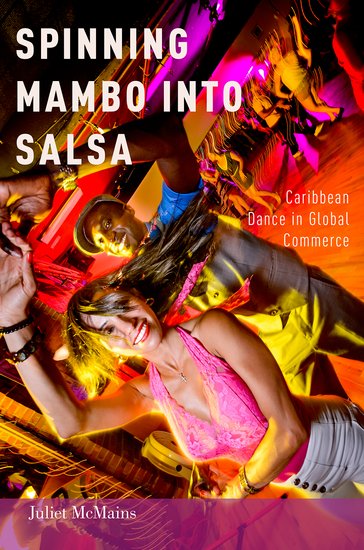
"Spinning Mambo Into Salsa" by Juliet McMains

Spinning Mambo Into Salsa
Illustration Copyright © 2003 University of California Press Ltd. All Rights Acknowledged.

The past five years has seen an increasing amount of literature published, in book format, concerned with the ethnography and sociology of popular Latin dance, whose primary target audience includes the interested non-Academic. I find this a welcome and much needed development, redressing the imbalance between the study of Latin music, which is richly explored, and of Latin dance, which has lagged behind. McMains' contribution has gone a long way into redressing that with respect to salsa, and may soon be regarded as a seminal work.

Through a combination of fieldwork, personal interviews, literature review, and secondary sources such as interview transcripts and internet videos, Juliet brings together a broad detailed tapestry of life in the mambo and salsa lane woven with compelling arguments. She is true to the realm of academic study, dispelling lore and revealing reconstructed histories, as she addresses polarising issues which continue to divide our salsa communities:
  • the on-1 versus on-2 rhythm debate;
  • mambo authenticities;
  • European versus African aesthetics;
  • salsa of the North versus salsa of the South, and
  • what it means to be a dancer in the modern era of internationalised Latin dance.
McMains achieves this through studies in three major loci: New York City, Los Angeles, and Miami; supported by secondary fieldwork in Havana, Puerto Rico, and passing observations in cities farther afield where she has taught. E special feature of note is her highlighting of the Hustle as 'the missing link' between Palladium style mambo and the modern New York style of salsa/mambo. Her tone is light and accessible, her scope of exploration intriguingly broad, her arguments persuasive with academic rigour.

Compelling though it is, there are some instances where her opinions and mine differ.

I would have liked to hear an Africanist voice in the rhythm debate; "on-1 versus on-2" dissolves in the face of how African percussionists perceive the rhythm-cycle, as does the significance of beat 2.

The exploration of son cubano on eastern Cuba (performed in an individual circular style also called 'rueda') was a glaring omission, one which I think weakened her conclusions across contratiempo and modern Cuban dance.

Her observations come across as drawn from the rarefied atmosphere of the elite dancer. Whilst I might agree with her conclusions on the prevalence of styles and dispositions, drawn from congress and workshop experience, I find that this differs greatly from what is happening at the international grassroots level of dancers taking their early steps at bars and clubs worldwide.

The African aesthetic, so well introduced early on, was a fading thread such that it had disappeared before the end. Opportunities were missed where its presence would have made a valuable contribution, for example in the re-working/re-imagining of African authenticities on congress performance.

The link between dance and music was underdeveloped, and allowed to be imbalanced with its focus on beat 1 and 2. For example I would have liked to hear her thoughts on salsa's matancerisation with its cumbia-esque bass-line and whether it had a relationship with on-3; or why beat 2 became the 'gold standard' over that of the ponché or beat 4.

There are weaknesses in the book: the kineschizoponia; the thready African perspective; the mono-cultural perspective drawn from elite dancers; the mis-pitching of the tagline "Caribbean Dance in Global Commerce" when it hardly addresses Europe nor Asia.

"Spinning Mambo Into Salsa" is a labour of love by an exceptional researcher who is a lover of dance. It is a fascinating insight into the salsa world of North America. It is a candle of truth to illuminate the salsa/mambo lore which has been constructed for commercial objectives. It is a gateway to the burgeoning field of dance sociology.ethnography. It is essential reading for anyone who loves salsa as much as Juliet McMains does. As I do.

Loo Yeo

Thursday, June 09, 2016

What Does A Dancer Need To Know About Percussion?

That's the question that's been burning since a specific Solares participant enthusiastically indicated that he wanted to know more about Afro-Cuban and African phrasing via percussion. But it's a 'what' question, not a 'why' question, which in the grand scheme of question hierarchy: Why > What > How, tells me I need to be thinking bigger picture.

So instead of asking "what does a dancer need to know about percussion?" I should be asking questions in that order, beginning with...

Why does a dancer need to know about percussion?
The writer Juan Luis Borges said, “art is fire plus algebra”. Passion plus skill. Dancers are already percussionists, it's just that most of them don't know it. Learning about percussion is an additional route to connecting a person's creative side with his or her physical manipulation side. It creates a more profound melding of the embodiment activity (dance) with music, building a complete synchronous sensory experience - tactile, aural and visual.

What does a dancer need to know about percussion?
I've been to a number of percussion workshops (usually part of congresses) where the deliverers described the rhythms and got the attendees to dance to them, But all of these were presented from the drummers perspective: there was no "this is what's important to you as a dancer, and this is how you use it". Hell, I've been guilty of doing the same before!

"What are the sounds?" and most crucially, "what to do they mean to a dancer?" must be the questions at the heart of adventure.

How does a dancer need to know about percussion?
Okay, the structure of the question makes it sound contrived, for good reason so as to simulate closer examination. The 'how' determines the realisation of the why and the what. How the learning experience is shaped affects the likelihood of the adventurer's realisation of meaning, and how much that meaning is valued.

On the basis of this, I have now to design a conga adventure programme for the hands of a dancer, that he or she may be enriched, and knowing so, through Afro-Cubanisation.

Yeo Loo Yen