Showing posts with label review: book. Show all posts

Saturday, June 11, 2016

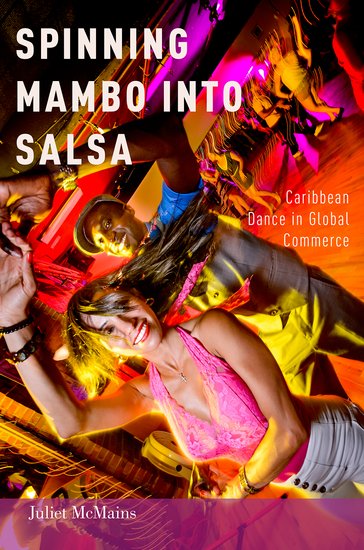
"Spinning Mambo Into Salsa" by Juliet McMains

Spinning Mambo Into Salsa
Illustration Copyright © 2003 University of California Press Ltd. All Rights Acknowledged.

The past five years has seen an increasing amount of literature published, in book format, concerned with the ethnography and sociology of popular Latin dance, whose primary target audience includes the interested non-Academic. I find this a welcome and much needed development, redressing the imbalance between the study of Latin music, which is richly explored, and of Latin dance, which has lagged behind. McMains' contribution has gone a long way into redressing that with respect to salsa, and may soon be regarded as a seminal work.

Through a combination of fieldwork, personal interviews, literature review, and secondary sources such as interview transcripts and internet videos, Juliet brings together a broad detailed tapestry of life in the mambo and salsa lane woven with compelling arguments. She is true to the realm of academic study, dispelling lore and revealing reconstructed histories, as she addresses polarising issues which continue to divide our salsa communities:
  • the on-1 versus on-2 rhythm debate;
  • mambo authenticities;
  • European versus African aesthetics;
  • salsa of the North versus salsa of the South, and
  • what it means to be a dancer in the modern era of internationalised Latin dance.
McMains achieves this through studies in three major loci: New York City, Los Angeles, and Miami; supported by secondary fieldwork in Havana, Puerto Rico, and passing observations in cities farther afield where she has taught. E special feature of note is her highlighting of the Hustle as 'the missing link' between Palladium style mambo and the modern New York style of salsa/mambo. Her tone is light and accessible, her scope of exploration intriguingly broad, her arguments persuasive with academic rigour.

Compelling though it is, there are some instances where her opinions and mine differ.

I would have liked to hear an Africanist voice in the rhythm debate; "on-1 versus on-2" dissolves in the face of how African percussionists perceive the rhythm-cycle, as does the significance of beat 2.

The exploration of son cubano on eastern Cuba (performed in an individual circular style also called 'rueda') was a glaring omission, one which I think weakened her conclusions across contratiempo and modern Cuban dance.

Her observations come across as drawn from the rarefied atmosphere of the elite dancer. Whilst I might agree with her conclusions on the prevalence of styles and dispositions, drawn from congress and workshop experience, I find that this differs greatly from what is happening at the international grassroots level of dancers taking their early steps at bars and clubs worldwide.

The African aesthetic, so well introduced early on, was a fading thread such that it had disappeared before the end. Opportunities were missed where its presence would have made a valuable contribution, for example in the re-working/re-imagining of African authenticities on congress performance.

The link between dance and music was underdeveloped, and allowed to be imbalanced with its focus on beat 1 and 2. For example I would have liked to hear her thoughts on salsa's matancerisation with its cumbia-esque bass-line and whether it had a relationship with on-3; or why beat 2 became the 'gold standard' over that of the ponché or beat 4.

There are weaknesses in the book: the kineschizoponia; the thready African perspective; the mono-cultural perspective drawn from elite dancers; the mis-pitching of the tagline "Caribbean Dance in Global Commerce" when it hardly addresses Europe nor Asia.

"Spinning Mambo Into Salsa" is a labour of love by an exceptional researcher who is a lover of dance. It is a fascinating insight into the salsa world of North America. It is a candle of truth to illuminate the salsa/mambo lore which has been constructed for commercial objectives. It is a gateway to the burgeoning field of dance sociology.ethnography. It is essential reading for anyone who loves salsa as much as Juliet McMains does. As I do.

Loo Yeo

Wednesday, August 17, 2011

"La Lucha For Cuba" by Miguel A. De La Torre

Illustration Copyright © 2003 University of California Press Ltd. All Rights Acknowledged.

I was drawn to this book by its cover: a protester clutching a Cuban flag, a sash of cordon tape across his chest, being restrained by three concerned blue-clad police officers. It looked familiar somehow, and it turns out that it was an exilic Cuban protesting at the Los Van Van concert at the Miami Arena. I remembered watching the DVD of the concert which opened with scenes of the protest, and wondering why salsa - a phenomenon which sometimes sells itself on the basis of Latin American unity - inspired such fervent anger.

There was another reason; research into augmenting the History of Salsa on my website, with sections on Colombian, Venezuelan and Miami salsa.

The author, Miguel A. De La Torre, writes about Miami exilic Cubans' power geometry in the contexts of Dade County, the United States, and against Castro's Cuba. The work unmasks the structures of oppression  deployed by exilic Cubans to maintain their position of power; it is piercingly insightful, utterly convincing and written with relentless candour. He is a brave man. I can only imagine what he risked as an insider, in the publication of 'La Lucha'. Laura Pérez, Associate Professor of Ethnic Studies in University of California Berkley, regarded it as an "... extremely important, courageous and long overdue project about cubanidad...".

It is heavyweight, erudite, and yet personal. It is not light reading. But difficult endeavours, and their accounts shouldn't be. His writing is compact, succinct, heavily laden with meaning. I think the value of his commitment is best be revealed through some of his own words (In order to avoid misunderstandings due to my purely personal choice of excerpts, I strongly urge you to obtain a copy of the book to read them in the context as the author intended):

In his preface he observes, "My hatred for Fidel Castro has been ingrained in me since childhood."

And of the institutionalized racism he and his family encountered when they moved from Miami to Kentucky he says, "The day we moved, I woke up "white" in Miami, but that night in Louisville I went to sleep as a man of color. This experience illustrated that while in Miami, I benefited from the power and privilege obtained by Exilic Cubans, yet when I left Dade County, I suffered because I was seen as a Latino."

And for me, most importantly,

"The Cuban clergy was predominantly from Spain... trained during the Franco dictatorship and highly influenced by the bitter Spanish Civil War victory over communism."
"These priests transplanted the atmosphere of a religious crusade against communism from Spain to Cuba."
"The Cuban Revolution occurred before the churches in Latin America became radicalized by the Vatican II (1962-65)... which articulated the basic tenets of liberation theology." [page 27]

This was the 'a-ha' moment - all of a sudden, things made sense. It was worth the cost of the book for the value of page 27 alone.

'La Lucha for Cuba' has brought me to a cross-roads. Should I augment the history with a deeper analysis which would necessitate consideration of political (and hence polarising) influences? Or should I maintain the history's accessibility to all by side-stepping the controversies which lie at the very heart of salsa?

Perhaps there is a middle path, should Elegguá be kind enough to show me the way. Otherwise, my instinct tells me I should follow De La Torre's example, and trust my readers to know the price of the difference.

Yeo Loo Yen

Tuesday, February 08, 2011

"The Book Of Salsa" by César Miguel Rondón. Translated from the Spanish, by F.R.Aparicio with J.White

Cover Illustration Copyright © 2008 J.T.Morrow. All Rights Acknowledged.

The original version has acquired near-mythic status as THE reference guide on the impact and development of salsa in the Caribbean with emphasis on Venezuela. This translated version finally makes this work accessible to the English-speaking audience.

Rondón's chronicle doesn't disappoint, providing a join-the-dots genealogy of salsa replete with interesting musical examples. His division of salsa into movements - the avante garde and matancerization; and by locale - salsa of the north (New York) and salsa of the south (Caribbean), are well argued; as his is take on the origin of gender narrative being guaperia, although his handling of the topic of sexism is far from deft.

The author's role in broadcast media placed him in prime position to witness and comment on salsa's impact on Venezuela: right from the very start as an imported music adopted by the urban underclasses facing censorship by the elite, through to Oscar D'León's productions for international consumption. His access to musicians and inclusion of interview material adds a much-needed counterpoint to the main narrative; I found Tite Curet Alonso's theory about love and the position of the bolero as being enriched by confrontation especially enlightening.

The storyteller is not above hyperbole and sensationalisation, and one would to well to remember that "The Book of Salsa" is no more than a personal account, and as such benefits (as above) and suffers (below) from all that that entails. It has instances of:
  • absolutism - "those Cuban examples... were always isolated experiments that had no support from dancers and music fans"
  • vague value judgement - "Lavoe did not (capitalize on the potential that Curet's lyrics)... show off through the montuno in new or creative ways"
  • lack of detail - failing to clarify what he means by "mediocre arrangements" and what constitutes a good one
  • blatant author filtering or poor editing - "however, for the purposes of this book, that does not matter much"
  • getting out of his depth - weak knowledge of resident Cuban musicians; misrepresenting an artist as two separate ones e.g. Francisco Repilado and Compay Segundo, Manuel Licea and Puntillita; poor gender commentary
  • poor internal consistency - "but those same nuances acquired a special, if negligible value" (under what conditions would something deemed special be also deemed negligible?)
  • affectation - where he confesses that there are "other erudite books free from intellectual prejudices"
It is a credit to Mr.Rondón that despite its faults, his work remains important. It provides the salsa researcher with the precious gift of investigative direction; admittedly one which, due to shortcomings in its stringency and internal consistency, requires corroboration with other sources.

Loo Yen Yeo

Wednesday, January 12, 2011

"Stage Presence" by Jane Goodall

Illustration Copyright © 2008 Routledge. All Rights Acknowledged.

An academic study describing the titled phenomenon, "Stage Presence" largely documents and analyses the efforts of others who have sought to describe it, rather than pointing in directions as to how it might be developed. Consequently, it is a step further removed from the vital attribute - listening to and critiquing the thoughts of others, leaving the reader to deduce its contextual significance.

Stage Presence's discursive quality is that of movement in an ever-tightening spiral; of trying to identify something ephemeral by describing everything around that's subject to its influence - like astronomers witnessing the effect of a strong gravitational field through the distortion of light from surrounding stars.

What lends cohesion to the work is the thread of a timeline, from the ancient to the recent, where the expressions of stage presence were drawn from the scientific understandings of that epoch: mesmerising, magnetic, electric, radiant, dazzling. Indeed, Goodall sets out her stall in the introduction by describing the work as "an enquiry that breaks down the cultural dualisms of rationality and superstition, science and art."

The book is, at its very superstructure, a Chronicle of Rhetoric. Within that framework is located some very succinct definitions, such as the meaning of 'Star Quality'; analytical dissections, for example in the 'Definition of Parody'; and practical applications, like 'the management of energy in performance'.

Whilst there are numerous useful insights and ideas, and the author comes across best when talking about musicals, the effort becomes less convincing when Goodall strays from the aesthetic domain into the scientific; where her words are beguiling but lacking in rigour - "nature abhors a vacuum" neglects the largest known phenomenon in nature: Outer space.

At times, the author seems to grasp at straws:

[Quote]

"Why do ghosts, which the French call 'revenants' - those who return - come back to the places from which they are supposed to have departed, and how do they achieve the presence effect? This is a question with which scientists would have no patience but, with a little poetic licence, it helps to raise some other questions that are of the essence in an enquiry into stage presence." (Page 170)

[Unquote]

Yes, skepticism is an inherent part of a scientific philosophy which West inherited from the Greeks. But I contend that scientists would indeed entertain her question above, if there was preceding reproducible evidence that:
  • ghosts did exist;
  • the returners were one and the same as the departed, only transcendental;
  • there was a quantifiable presence effect; and
  • such presence effect was caused by ghosts.
In the next line, she asks the reader for an act of faith (in the form of poetic licence) in order to bridge a gap in logical argument in an enquiry.

I found the pseudoscience hard to swallow.

With any advanced material, it is encumbent on the reader to maintain a critical mindset to recognise personal truths. "Stage Presence" is no different. Indeed, I found the discourse on Dramatic Interpretation: the "use of repetition - verbal and melodic - to create variation, so that their unfolding is improvised line by line with a fresh interpretive attack" particularly relevant to the performance of salsa.

But it is in the analysis of John Cage's 'now moment' as "the vanishing point in time and space" that I found my personal nirvana. Coming as it did in the closing stages of the book, it vindicated my doggedness in seeing the book through to its end in the face of a scientist's umbrage.

It articulated clearly that which I'd experienced as, "a shift in consciousness resulting in break-through to some normally excluded dimension of experience" but had never been able to express personally in words. Understanding the distance Science has yet to cover, I would not attempt a logical explanation.

Stage Presence is a valuable endeavour whose riches require considerable effort by the reader to unlock. Those of a more scientific bent would have to exert themselves a little more in the suspension of their disbelief.

Loo Yeo

Thursday, November 11, 2010

"The Art Of The Solo Performer" by Steve Rapson

Illustration (left) ©Copyright 2007 Steve Rapson. All Rights Acknowledged.

This book is lavished with personal insight about the music performance business. From cover to cover, the witty, mischievous, and sometimes moving morsels of wisdom pose as answers to rhetorical questions, like:

Should I fire my manager?
What is a song plugger?
How come everybody doesn't recognize my greatness?

Mr.Rapson's style is easy to read, making light work of deceptively profound performance truths gleaned at the coal-face of Boston's acoustic musicians circuit. It is less of a field guide, and more of a field journal: the sort of book that rewards re-reading as you develop.

Steve makes little distinction between musical performance and public speaking, and understandably so: unless you're as great as the late Roy Orbison, most artists have to have a little patter between the numbers.

Although the ideas are arranged into the major categories of Philosophy, Business, Material, Performance, and Public Speaking, they are still quite modular in nature; so it's worthwhile making notes and arranging them in a way that suits your own mind.

Clever, honest, funny and perceptive. There's always something on its pages for you as a performer to think about; be you a fledgling to the stage or a seasoned hand. Having "The Art Of The Solo Performer" next to you is like having your own personal performance consultant, and therein lies the rub: consultants help you understand what should be done, but you still gotta do it yourself.

He makes mark of that in the Addendum.

Steve Rapson's book is a deserved classic.

Loo Yeo

Tuesday, October 19, 2010

"Stage Presence From Head To Toe" by Karen A. Hagberg

Illustration (left) ©Copyright 2003 The Scarecrow Press, Inc. All Rights Acknowledged.

This work strangely only gets going halfway through - as if the author began with what she knew best, worked through to the end, and then addressed what she considered the ancillaries; some of which were placed at the beginning. Consequently the sections following "The Orchestra" on page 47 inclusive are most coherent; while those preceding, for example "The Small Ensemble", read as a largely repetitive subset of this 109 page publication (including Bibliography).

All the material, set within the realm of classical rendition, is based on the principle of 'The Listener's enjoyment of the Music is paramount, and anything that distracts the Listener from its performance should be eliminated'.

While such a defensive approach does have value, it by no means portrays the full story; there is negligible mention of how a special rapport might be established with the audience, and nothing at all about how it might be enhanced. As such, the marketing of Dr.Hagberg's work under the title "Stage Presence" is hardly justifiable. "Stage Conduct" would have been less sexy but more apt.

There are some "Don'ts" and too few "Dos"; most iterated more than a handful of times, and the book does positively boast illustrations which drive the points home very well indeed.

Dry, procedural and uninspiring... it is an attempt which could have been précised in less than half the space. If the publishers had had a certain minimum size in mind (as I'm sure they would have done), then there would have been plenty of room for personal insight - Dr. Hagberg presents workshops and offers consultancy in this area, and thus should have had plenty of scope to demonstrate her expertise. Sadly, this was overlooked.

Overall, "Stage Presence From Head To Toe" is a flawed endeavour; an squandered opportunity whose strong concept deserves a well-planned revision.

Loo Yeo

Sunday, September 12, 2010

"Guide To Karaoke Confidence" by Jeffrey Allen

Illustration Copyright © 1995 Warner Bro. Publications Inc. All Rights Acknowledged.

Aspiring performers, discount this publication on account of its title at your peril!

If the mark of true understanding is the ability to distill that which is complex into a work of simplicity and brevity, then Jeffrey Allen is a Master of Performance and Singing. This is the quickest route to getting ready for vocal performance bar none.

The blurb describes it as: "A quick, simple and fun course for everyone who loves to sing. Designed for all vocal ranges and styles, Jeffrey Allen's Guide to Karaoke Confidence offers numerous, invaluable performance and singing tips to insure that each and every moment in the Karaoke spotlight is successful."

I can attest that the schedule of development is indeed brief, easy to follow, and has plenty of lively learning points. I make it no secret that I'm a fan of Jeffrey Allen's work and found the second part: "The Vocal Makeover: Tricks, Tips, And Secrets Of Singing" highly familiar, drawn as it is from his comprehensive "Secrets of Singing".

But for those who can already sing, and to some extent those who can play, it's "Part 1: Secrets of Living Comfortably Onstage" which promises the elevation from musician to performer - it details succinctly the mental preparation required to take to stage. Even then, a good deal of effort needs to be invested on your part; those hoping for the lurking of magic words in Mr.Allen's handbook, the mere reading of which to transform them instantly into a mesmerist on stage, are going to be sorely disappointed.

Take, for example, the critical self-reflection he demands of the singer in order to breathe life to performance:
  • "Why did I choose to sing this song...?"; and
  • "To whom am I singing this to?";
are but a pair of sample questions. Applying them all in turn to each song, yields insight into and artistic confidence in, every work.

Pound for pound, word for word, the compact "Guide to Karaoke Confidence" provides the best value in self-schooling for the Performing Arts.

Loo Yeo

Wednesday, July 15, 2009

'Situating Salsa' edited by Lise Waxer

is a collection of thirteen essays by twelve authors, with two of them being written by Lise Waxer and another two translated by her. It strikes me that the intent of the volume is to let salsa be spoken of by many voices, and as such the content shifts significantly in perspective: from the socially scientific, the musically analytical, the weightily philosophical, to the personally meaningful.

Through the book's myriad of tonal textures, salsa is presented as a multifaceted entity - an approach which challenges, informs, and encourages the reader to (re)define what salsa means to him or her. It is a mature collection allowing differing opinions to be expressed, simultaneously keeping them discrete by chapter so as to avoid dissonance.

'Situating Salsa' achieves its overall coherence despite its international scope by organising the contributions into three sections of progressive themes:
  1. Locating Salsa in its mainspring environments - geographically, sociologically, musically;
  2. Personalising Salsa through biography; and
  3. Relocating Salsa in its diaspora;
hence the book's subtitle 'Global Markets and Local Meaning in Latin Popular Music'. I particularly noted the use of both 'salsa' and 'Latin popular music' on its front cover; since there is considered treatment as to whether salsa has evolved from a catch-all marketing term to a legitimate genre, and treatment of the boogaloo as its precursor. There is something here for everyone: from the interested hobbyist dancer or musician to the career musicologist, and it will reward you upon every revisit. What it does not have is the single thread of one storyteller. Instead think of its broad compass as akin to what you might encounter at an animated dinner party, you'd not be off the mark - because you'd take your leave satiated from all the variety, having learned something new, and with plenty to ruminate on.

'Situating Salsa' is recommended reading if you're beginning to wonder about what salsa means to you.

Loo Yeo

Friday, August 08, 2008

"Mambo Kingdom: Latin Music In New York" by Max Salazar

This book had been on my 'to acquire and study' list for a very long time. Many of the books I'd read had cited Max Salazar's work, and I was conscious of its significance. This was supported by a number of glowing reviews, but in contradiction, I found it curious when trying actually getting a hold of a copy that it was no longer in print.

Personally I had just come off the back of Ned Sublette's "The World That Made New Orleans", and was expecting a work of similar stature. Anybody who has had the pleasure of encountering Mr.Sublette's work could justifably accuse me of having unrealistic expectations.

It turns out that 'Mambo Kingdom' is a collection of articles written by Max Salazar that were previously published primarily in 'Latin Beat' magazine, with the remainder in others like 'Impacto'. This wasn't alluded to in any of the reviews that I came across.

Most of the articles are biographical and based on taped interview material between the author and the relevant artist, the latter of whom are stellar: ranging from Miguelito Valdés and Vicentico Valdés to José Curbelo (a glaring omission is Celia Cruz despite her presence during the time-span). Significant phenomena in the mambo world such as The Palladium, Charanga, and Salsa Origins are treated from the participant-observer perspective.

Max Salazar writes authoritatively and allows the reader to live the mambo times through is eyes in New York City. As temporally-spaced single articles, they might be appreciated by fellow residents of the era as entertaining commentaries. But juxtaposed as they sequentially in the pages of the book, the material comes across as being repetitive and contradictory - some as rehashed from others. It is easy to accept that two luminaries might have distinct interpretations of a key event; to a critical thinker it's even valuable to have those contradictions. However, what is unforgivable is the lack of authentication of facts that are easily verifiable.

For example, in the Tito Rodríguez article, the report of Tito's final day is dated as February 28, 1972 not 1973. That might seem like a small typographical error that succeeded in slipping past Mr.Salazar, and his then magazine editor, but it also slipped past the book publisher too... two pages later, the cremation of Tito's remains regains the correct timeline. In a separate instance, the founding of Broadcast Music Incorporated (BMI) the performing rights organisation is incorrectly reported as formed in 1940 (actually 1939).

The lack of rigour in proofing and in verification, even with the simplest of facts, put me in the frame of mind of "if he got these minor things wrong, how can I trust him on the important issues - like the faithful transcription and interpretation of his interview material?"

'Mambo Kingdom' has more than its fair share of errors, plus snippets of information that have eluded verification so far. These have cast a long shadow of doubt over the factual integrity of his writing. It is a flawed work, and vitally interesting though it may be, must be treated simply as entertainingly anecdotal and thus relegated to the status to that of a secondary resource.

With such a topic of immense richness and historical significance, 'Mambo Kingdom' is simultaneously essential reading and a bitterly disappointing pill to swallow.

Loo Yen Yeo

Wednesday, May 28, 2008

"The World That Made New Orleans: From Spanish Silver To Congo Square" by Ned Sublette

While midway through Ned Sublette's first book "Cuba and Its Music: From the First Drums to the Mambo", I was so gripped by it that I found myself already eagerly anticipating the second volume. When the announcement came that he had delayed it in favour of a book on New Orleans, I cried "Why?" in disappointment. To me it seemed a strange detour to take. I had enjoyed his work immensely and in my selfishness wanted the story of Cuba to continue.

To all of you who have read the first book, I'm sure you would want to follow it up with this volume. Please don't make the mistake I almost did by discounting it just because New Orleans is more commonly associated with Jazz and Blues than it is Mambo and Rumba.

I feel that the general reviews of "The World That Made New Orleans", albeit excellent, have missed a trick here. This book is, as the dust cover puts it, "a logical continuation of Ned Sublette's previous volume, Cuba and Its Music"; and as such is entirely relevant to the Cuban story. After having read it, I now understand some of the "Why".

Ned Sublette alluded to the invisible water highways of the Caribbean linking all the major trading centres: the port cities, lining the entire basin and of the islands. New Orleans has consistently been a major trading partner of Havana, and later a base for privateers preying upon Spanish shipping. It was a similar hub for sugar and slaves of the "white gold" territories, and destination of exile for the French colonial elite via Baracoa and Santiago de Cuba. They would have been non-identical twins.

Mr. Sublette describes this story as joining the dots between La Española, Cuba, and Louisiana; between the French and Haitian Revolutions. I think he's being modest, his narrative is simply more multi-dimensional than that. Consider instead the threads of history - strands passing through Santo Domingo, Saint Domingue, Havana, Santiago, New Orleans, Cartagena, Paris, Madrid, Seville, Charleston... all skilfully woven into a compellingly vibrant tapestry with clear motifs.

His gift to all of us who would learn of Cuba is to discard the blinkers we didn't realise we were wearing.

I would not have thought it possible for him to write more authoritatively than in Cuba and Its Music. I've been proved wrong (and I've never been happier for the making of these errors). Ned Sublette is an unsurpassed talent. And should he persist along this skein, I will delightedly continue to think upon whatever he has to say.

Loo Yen Yeo

Tuesday, May 27, 2008

"Arsenio Rodriguez and the Transnational Flows of Latin Popular Music" by David F. García

Seldom does a single person make such a contribution to the development of Afro-Cuban music that his or her biography alone would form a significant chapter in the genre's history.

Arsenio Rodriguez is such a man.
And David García is such a storyteller.

I've read a number of these books, each seemingly drawn from a musicologist's thesis; and whilst thoroughly researched, logically structured, bearing robust arguments and defensible conclusions, I found a good deal of them a little dry. Not this one.

Yes, it is true that having some knowledge of music and being able to read it does help quite a bit. But I think the author has succeeded in being able to render what he has to say accessible to the layperson. The contents are laid out in chronological order, allowing the reader to appreciate the formative events in Arsenio's life and thus insight as to what moved him. A posthumous reflection on this remarkable musician's life followed.

For a man whose creativity gave us arguably, the mambo before its internationalised guise; definitively, the second coming of the son in the form of the son montuno; and the entire rhythm section of what forms salsa today: introducing the tumbadoras, developing the guajeo/montuno rhythm, and solidifying the role of the bass, Arsenio's name is little recognised outside the circles of aficionados. Whatismore, his life is shrouded in myth and hearsay - as all Great Legends' are. David García's erudite work does much to explain Arsenio Rodriguez, the man and his music: dispelling much, explaining much, and revealing an even greater man over the course. Arsenio still remains arguably the most significant songwriter of all time.

If that's not enough, then let me put it another way: if you want to know what mambo might have meant before the Palladium, and the difference between a son and a son montuno, pick up the book.

Tuesday, May 13, 2008

"Bachata: A Social History of Dominican Popular Music" by Deborah Pacini Hernandez

What Deborah Pacini Hernandez does extremely well is to tell the human story of Bachata. Not once, in the easy-flowing course of narrative, does she ever lose sight of the principle that the music and dance of bachata were made by and for the consumption of people; endeavouring, as best they could, to negotiate the unhappy circumstances of their existence during the Dominican Republic's economic crises.

This is not a dry tome minimally reworked from the academic thesis of a musicologist. It is laden with the juices of humanity: bitter, sweet, sour, piquant and oftentimes salty. From bachata's rural origins as simple guitar music, its migration to the shanties, its supression, its marginalisation, and its eventual unshackling, Hernandez tells one of the greatest stories never given proper voice in modern music.

For one seeking to understand what bachata is, you will not do better than this book. Be prepared though, you will get an object lesson in what it means to be human - disinterested depravation and the determination to be heard wrestle with each other across all the pages. It is a lens through which musics raised in the same foster home: rap, reggae, salsa, might be better understood.

The book stops short, just at the threshold of Bachata's revelation on the international stage. It is a shame but then it is neat, in that those who would part the curtain behind 'Aventura' to see bachata as it was before, can do it with just one well-written book. And in so doing, will come to be reminded that bad humans do bad things; and at the same time will still take heart... for good people do act to overcome injustice.

Loo Yen Yeo

Friday, October 27, 2006

"Salsa Talks" by Mary Kent

"Salsa Talks" is another book that I'd managed to finish just recently.

It's a large book, comprising intimately candid interviews coupled with some marvellous photographs; a volume that brings the protagonists of salsa to life in a way that I've found no other book has been able to.

Despite the dedication of a good portion of its contents to pictures, sometimes duplicated which left me wondering if it was a design feature or "padding", the interview transcriptions are meaty but simultaneously easy to read. This is a welcome change from the normal fare which is either extremely well researched but stodgy, being derived from someone's musicology thesis; or so under-researched and misrepresented as to be misleading.

This book is SUCH a refreshing change.

Salsa Talks gives something back to you every time you read it: the way the artists express themselves about their work; their recollection of the times; their hopes. Many of them have passed on now, a comment on how long Mary's journey has been.

It has helped me personally on so many levels:

1. much of the flotsam of information I'd gathered from a multitude of sources finally came together within the context of the narratives, making salsa clearer and more comprehensible;

2. my listening appreciation of music became more profound as I came to understand what the artists were personally going through and thinking at that time; and

3. their comments about how they approached their work gave me valuable insight into how I might interpret salsa myself as a musician.

Over and above everything else, Salsa Talks communicates with passion, a sense of Time and Place; that's something books don't do often enough.

I'm glad that this one is with us, because it makes us all the richer for it.

Loo Yen Yeo

"Cuban Music from A to Z" by Helio Orovio

Illustration (left) ©Copyright 2004 Duke University Press. All Rights Acknowledged.

I've just finished reading Helio Orovio's "Cuban Music from A to Z", which I'd been meaning to do for a while now, but thought the prospect of tackling it in Spanish a little daunting. Luckily my courage was given a reprieve when the translated version hit the shelves a couple of years back. The encyclopedic entries make reading the book a very dry experience if you approach it from cover-to-cover, which is understandable as it was designed as a reference work.

Nonetheless, doing so at a leisurely canter gave this reader a sense of the book's scope, what the author thought to be important, and what is not so. It would be unfair to dwell on its inaccuracies: like the unlikelihood of people dying before they were born; or some of its glaring omissions like not mentioning the likes of Pedrito Calvo whilst maintaining and entry for his colleague Orlando Canto; simply because this work has no equivalent in the English language arena.

The balance of information seems to be heavily polarised, with plenty of weight given to musicians of Cuban-European music and practices of African origin, with not much in between. It's as if the cataloguing began with a very pro-European bias, and was only recently redressed with some very Africa-centric entries in an attempt to render it some sense of balance. It's a far from perfect work, but its very utility will ensure that Mr. Orovio's name will continue to stare back at me from spine of the book on the shelf for many years to come.

And one final thing.

Reading it serially, hard on the palate though it might have been, gave me a sense of the Cuban contribution, in part, to the development of salsa.

But tellingly, it was missing the names of non-Cubans commonly mentioned as staples in other books of this genre, that told me just as much. The likes of Johnny Pacheco, the Palmieri brothers, and El Gran Combo. I guess there is truth in the saying "You don't recognise the value of something until it's gone".

Loo Yen Yeo