Showing posts with label ethnomusicology. Show all posts

Wednesday, September 13, 2017

Contratiempo Rueda: Enchufla Is A Combination

Knowing in advance that this Solares was a double session, I chose to plan this as a substantial two plus hour masterclass; something I could afford to do based on the premise that all the attendees would have had significant prior experience.

Objectives
There were two learning objectives, broad enough enough to be considered contexts:
  1. the continued performance of dance using contratiempo phrasing to the bongó's martillo - this would serve to ingrain the phrasing to the same naturalised extent as atiempo; and,
  2. to investigate, in both 'big picture' and fine detail, the structure of one of rueda de casino's most basic pieces of vocabulary: the 'enchulfa' - as a basis for identifying and executing essential dance skills.

Rationale: Learning Group configuration
The learning group was set up into:
  1. a membership of three: two leaders, one follower, and one virtual follower; and consequently,
  2. into a rueda de casino square of two pairs; and,
  3. partnerships without hold.
For leaders, the alternation between real and virtual followers would test, clarify and validate their spatial positioning. The square configuration of two pairs would create the most demanding angles in the performance of rueda de casino. If they could cope with this, every other configuration would be easy. The requirement for good visualisation would be laid bare through negating the use of the arms.

Concept: Revealing "enchufla" as a combination
The group was shown how the "enchulfa" move comprises three sequential change-of-place components of enchulfa, dame, and dile que no where:
  1. enchufla is a simple change of place clockwise, incorporating a follower's left turn;
  2. dame is a simple change of place clockwise, ending with a 90 degree change of orientation - followers to the right, leaders to the left - to acquire new partner;
  3. dile que no is a simple change of place anti-clockwise.
As a result of component 2 (dame), there is a net group rotation of 90 degrees clockwise.

Warm Up
Partnered, without hold, to music. Calls used were "dame" and "enchufla-dame-dile que no". Calling was federated. The group was given time to get their bearings with the new orientation angles. It took two songs.

Exercise One: Pockets of Synchronisation
Dancers were asked to focus on their 'pockets of synchronisation' - phases in their dance where they were most available for synchronisation - corresponding to their martillo vocalisation of "toc-y-tik-y". The application of this point was most easily observed in the leaders when with their virtual follower. When asked at the end of this exercise, all dancers responded that they positively felt more 'in tune' with each other.

Exercise Two: Dame Pocket of Synchronisation 
I drew participants' attention to their movement ensuing from the 'dame' call, indicating that it lacked completion. Both followers and leaders, especially the latter, needed to end their movement not just oriented to their new partner, but finishing in a manner which made them available to be synchronised with. I called this the acquisition phase.

This stimulated a useful discussion about the moment preceding acquisition, when there was a tapered ending with the current partner before a smooth beginning with the new partner. I likened it to the use of a clutch in a car when changing gears.

Concept: Change-of-Place
Participants had exposed to the idea of change-of-place previously in our merengue sessions. The major difference between that then, compared to the change-of-place from the Caribbean Sway, is that the latter requires the places to be traded in two steps, not three. The first step of the Caribbean Sway is behind into close third position, which only leaves the second and third steps for movement.

The first step into reverse close third position 'loads up' the body and prepares it for movement through stacked torque curves in an upward cascade through the joints. This provides the drive of the second step taken, not directly into, but slightly diagonal of the partner.

Followers are led to trace a route of an asymmetrical "V": longer and shallower angled on the second step; shorter and more steeply angled on the third step. Leaders move themselves through the counterpart route around the partnership's axis of symmetry. Both routes together result in an oblique parallelogram, or offset diamond. The symmetry of the routes is indicative of the equal effort contributed by both partners to the movement.

This still holds true if either partner is executing a turn.

Exercise Three: Change-of-Place
The change-of-place movement was practised in partnership, first without music, then to martillo, then to music. The learning points provided were:
  • "aim for your partner's shoulder" (on the passing side); and,
  • "skimming around/almost brushing the turning partner's back with your chest".

Exercise Four: Caribbean Sway with Major Turn
I introduced a variant of the Caribbean Sway incorporating a major turn - turn in the same direction as the stepping leg (i.e. if stepping onto the right leg, then a rightward turn, or a leftward turn if stepping onto the left leg) - commencing on the second step. The rotation continues through the third step during the 'tok-y-tik', completing on the final '-y'. The turn is distributed across two bearings, created by the balls of both feet on the floor, and thus changes from a major turn in step two, to a minor turn in step three.

This is a common movement in rueda de casino, performed for example by the follower during enchufla.

Briefing: The Transnational Martillo
I was keen, with this being an extended session, to maintain participants' touch with music. And so, I took the opportunity to put my ethnomusicologist hat on, and provide some background to the existence, history, evolution and importance of the martillo rhythm in Caribbean music. I used 90 as the magic number, and began with two occurrences:
  • 1990 as the date of release of "Bachata Rosa" by Juan Luis Guerra, the album which brought bachata to international prominence; and,
  • 1890 as the beginning of Cuba's struggle for independence, which resulted in Sindo Garay's flight from Cuba to Dominica.
The discussion touched on the turbulent history of Haiti and Dominican Republic, the whitening of the latter, and how it impacted the interpretation and performance of its music and dance. The emphasis was on the shared origins of itinerant Cuban son and Dominican música de guitarra.

The Main Practice Session
All these elements were incorporated into rueda de casino practice, in square format, using only the elements of enchufla, dame, and dile que no, to federated calls. Music alternated between slow-tempo son and bachata, to up-tempo son montuno and salsa. Slower music emphasised control and primed movement, quicker music brought excitement and forced assimilation.

By the session's end, all participants had reached learning saturation and were physically tired, but enough practice had been done for the major points to be assimilated - ready for another double-session next week.

Loo Yen Yeo

Saturday, June 11, 2016

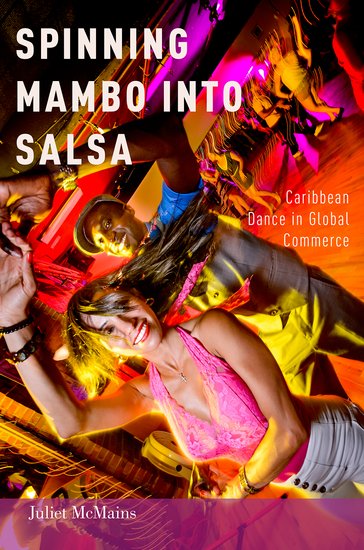
"Spinning Mambo Into Salsa" by Juliet McMains

Spinning Mambo Into Salsa
Illustration Copyright © 2003 University of California Press Ltd. All Rights Acknowledged.

The past five years has seen an increasing amount of literature published, in book format, concerned with the ethnography and sociology of popular Latin dance, whose primary target audience includes the interested non-Academic. I find this a welcome and much needed development, redressing the imbalance between the study of Latin music, which is richly explored, and of Latin dance, which has lagged behind. McMains' contribution has gone a long way into redressing that with respect to salsa, and may soon be regarded as a seminal work.

Through a combination of fieldwork, personal interviews, literature review, and secondary sources such as interview transcripts and internet videos, Juliet brings together a broad detailed tapestry of life in the mambo and salsa lane woven with compelling arguments. She is true to the realm of academic study, dispelling lore and revealing reconstructed histories, as she addresses polarising issues which continue to divide our salsa communities:
  • the on-1 versus on-2 rhythm debate;
  • mambo authenticities;
  • European versus African aesthetics;
  • salsa of the North versus salsa of the South, and
  • what it means to be a dancer in the modern era of internationalised Latin dance.
McMains achieves this through studies in three major loci: New York City, Los Angeles, and Miami; supported by secondary fieldwork in Havana, Puerto Rico, and passing observations in cities farther afield where she has taught. E special feature of note is her highlighting of the Hustle as 'the missing link' between Palladium style mambo and the modern New York style of salsa/mambo. Her tone is light and accessible, her scope of exploration intriguingly broad, her arguments persuasive with academic rigour.

Compelling though it is, there are some instances where her opinions and mine differ.

I would have liked to hear an Africanist voice in the rhythm debate; "on-1 versus on-2" dissolves in the face of how African percussionists perceive the rhythm-cycle, as does the significance of beat 2.

The exploration of son cubano on eastern Cuba (performed in an individual circular style also called 'rueda') was a glaring omission, one which I think weakened her conclusions across contratiempo and modern Cuban dance.

Her observations come across as drawn from the rarefied atmosphere of the elite dancer. Whilst I might agree with her conclusions on the prevalence of styles and dispositions, drawn from congress and workshop experience, I find that this differs greatly from what is happening at the international grassroots level of dancers taking their early steps at bars and clubs worldwide.

The African aesthetic, so well introduced early on, was a fading thread such that it had disappeared before the end. Opportunities were missed where its presence would have made a valuable contribution, for example in the re-working/re-imagining of African authenticities on congress performance.

The link between dance and music was underdeveloped, and allowed to be imbalanced with its focus on beat 1 and 2. For example I would have liked to hear her thoughts on salsa's matancerisation with its cumbia-esque bass-line and whether it had a relationship with on-3; or why beat 2 became the 'gold standard' over that of the ponché or beat 4.

There are weaknesses in the book: the kineschizoponia; the thready African perspective; the mono-cultural perspective drawn from elite dancers; the mis-pitching of the tagline "Caribbean Dance in Global Commerce" when it hardly addresses Europe nor Asia.

"Spinning Mambo Into Salsa" is a labour of love by an exceptional researcher who is a lover of dance. It is a fascinating insight into the salsa world of North America. It is a candle of truth to illuminate the salsa/mambo lore which has been constructed for commercial objectives. It is a gateway to the burgeoning field of dance sociology.ethnography. It is essential reading for anyone who loves salsa as much as Juliet McMains does. As I do.

Loo Yeo

Wednesday, May 11, 2016

Genres, International - The End of the Beginning.

Two years ago, I accepted a commission to write an entry for the international volume of Bloomsbury Academic's Encyclopedia of Popular Music of the World (EPMOW). I finally submitted the first draft earlier today.

Two years might seem a long time, and most instances it is. But what experience I have, in coming into contact with the process of producing a print encyclopaedia, it isn't that long at all. It's a task of Herculean levels: commissioning, chasing, reading, reviewing, re-drafting, and most of all it can't be sent for publication until everything, and I mean everything, is in.

This is my second commission for the publication. Curiously my first commission was for this, the international volume. But having completed it, I was asked if I'd be happy to move it to the 'EPMOW Genres: Caribbean and Latin America' volume. Flattered to be recognised as a cultural insider, I said "yes". This left an unfulfilled entry in the 'International' volume, which once again I accepted.

What I failed to appreciate was how much more of a challenge it would prove to be.
  1. The international entry had to offer a complementary voice
    There were already two entries on salsa: one in the North American volume by Chris Washburne, and the other, mine, in the Caribbean and South American one.
  2. Most research was Latino-centric
    The vast proportion of publications in the field were by researchers in North America, some of whom were of Latin American extraction, which were re-workings of their postgraduate theses.
  3. International salsa is less explored
    The practice of salsa in the international field differs significantly to that in Latin American, and is an area of research which is currently under-developed.
My original approach proved too Latino-centric, based on tools in ethnomusicology and sociology developed for analysis in those communities. They failed adequately to explain what I and my peer researchers have observed in the international scene. I ditched five attempts at structure, each taking weeks of effort, until finally arriving at one which tells the story of how salsa is changing as it spreads across the international field. Two of the stand-out references, which I will review later, were highly informative: one on dance subcultures; and the other describing the much-contested development of the salsa dance milieu out of son, mambo and Latin hustle. Both of these I will review later.

I don't know how this will be received. The approach I took is novel (it had to be) based on the difference in context, and lack of suitable analytical tools. What is certain, is that there'll be lots of to-ing and fro-ing until publication.

Right now, I'm just enjoying the peace.

Loo