Showing posts with label salsa history. Show all posts

Saturday, June 11, 2016

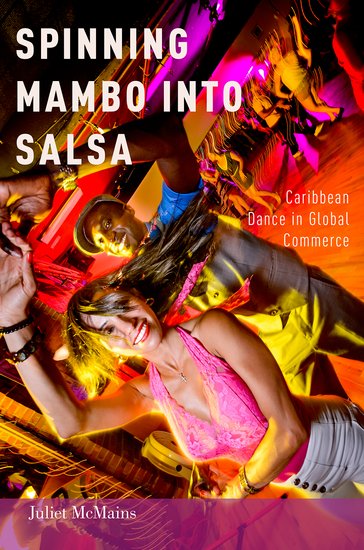
"Spinning Mambo Into Salsa" by Juliet McMains

Spinning Mambo Into Salsa
Illustration Copyright © 2003 University of California Press Ltd. All Rights Acknowledged.

The past five years has seen an increasing amount of literature published, in book format, concerned with the ethnography and sociology of popular Latin dance, whose primary target audience includes the interested non-Academic. I find this a welcome and much needed development, redressing the imbalance between the study of Latin music, which is richly explored, and of Latin dance, which has lagged behind. McMains' contribution has gone a long way into redressing that with respect to salsa, and may soon be regarded as a seminal work.

Through a combination of fieldwork, personal interviews, literature review, and secondary sources such as interview transcripts and internet videos, Juliet brings together a broad detailed tapestry of life in the mambo and salsa lane woven with compelling arguments. She is true to the realm of academic study, dispelling lore and revealing reconstructed histories, as she addresses polarising issues which continue to divide our salsa communities:
  • the on-1 versus on-2 rhythm debate;
  • mambo authenticities;
  • European versus African aesthetics;
  • salsa of the North versus salsa of the South, and
  • what it means to be a dancer in the modern era of internationalised Latin dance.
McMains achieves this through studies in three major loci: New York City, Los Angeles, and Miami; supported by secondary fieldwork in Havana, Puerto Rico, and passing observations in cities farther afield where she has taught. E special feature of note is her highlighting of the Hustle as 'the missing link' between Palladium style mambo and the modern New York style of salsa/mambo. Her tone is light and accessible, her scope of exploration intriguingly broad, her arguments persuasive with academic rigour.

Compelling though it is, there are some instances where her opinions and mine differ.

I would have liked to hear an Africanist voice in the rhythm debate; "on-1 versus on-2" dissolves in the face of how African percussionists perceive the rhythm-cycle, as does the significance of beat 2.

The exploration of son cubano on eastern Cuba (performed in an individual circular style also called 'rueda') was a glaring omission, one which I think weakened her conclusions across contratiempo and modern Cuban dance.

Her observations come across as drawn from the rarefied atmosphere of the elite dancer. Whilst I might agree with her conclusions on the prevalence of styles and dispositions, drawn from congress and workshop experience, I find that this differs greatly from what is happening at the international grassroots level of dancers taking their early steps at bars and clubs worldwide.

The African aesthetic, so well introduced early on, was a fading thread such that it had disappeared before the end. Opportunities were missed where its presence would have made a valuable contribution, for example in the re-working/re-imagining of African authenticities on congress performance.

The link between dance and music was underdeveloped, and allowed to be imbalanced with its focus on beat 1 and 2. For example I would have liked to hear her thoughts on salsa's matancerisation with its cumbia-esque bass-line and whether it had a relationship with on-3; or why beat 2 became the 'gold standard' over that of the ponché or beat 4.

There are weaknesses in the book: the kineschizoponia; the thready African perspective; the mono-cultural perspective drawn from elite dancers; the mis-pitching of the tagline "Caribbean Dance in Global Commerce" when it hardly addresses Europe nor Asia.

"Spinning Mambo Into Salsa" is a labour of love by an exceptional researcher who is a lover of dance. It is a fascinating insight into the salsa world of North America. It is a candle of truth to illuminate the salsa/mambo lore which has been constructed for commercial objectives. It is a gateway to the burgeoning field of dance sociology.ethnography. It is essential reading for anyone who loves salsa as much as Juliet McMains does. As I do.

Loo Yeo

Wednesday, May 11, 2016

Genres, International - The End of the Beginning.

Two years ago, I accepted a commission to write an entry for the international volume of Bloomsbury Academic's Encyclopedia of Popular Music of the World (EPMOW). I finally submitted the first draft earlier today.

Two years might seem a long time, and most instances it is. But what experience I have, in coming into contact with the process of producing a print encyclopaedia, it isn't that long at all. It's a task of Herculean levels: commissioning, chasing, reading, reviewing, re-drafting, and most of all it can't be sent for publication until everything, and I mean everything, is in.

This is my second commission for the publication. Curiously my first commission was for this, the international volume. But having completed it, I was asked if I'd be happy to move it to the 'EPMOW Genres: Caribbean and Latin America' volume. Flattered to be recognised as a cultural insider, I said "yes". This left an unfulfilled entry in the 'International' volume, which once again I accepted.

What I failed to appreciate was how much more of a challenge it would prove to be.
  1. The international entry had to offer a complementary voice
    There were already two entries on salsa: one in the North American volume by Chris Washburne, and the other, mine, in the Caribbean and South American one.
  2. Most research was Latino-centric
    The vast proportion of publications in the field were by researchers in North America, some of whom were of Latin American extraction, which were re-workings of their postgraduate theses.
  3. International salsa is less explored
    The practice of salsa in the international field differs significantly to that in Latin American, and is an area of research which is currently under-developed.
My original approach proved too Latino-centric, based on tools in ethnomusicology and sociology developed for analysis in those communities. They failed adequately to explain what I and my peer researchers have observed in the international scene. I ditched five attempts at structure, each taking weeks of effort, until finally arriving at one which tells the story of how salsa is changing as it spreads across the international field. Two of the stand-out references, which I will review later, were highly informative: one on dance subcultures; and the other describing the much-contested development of the salsa dance milieu out of son, mambo and Latin hustle. Both of these I will review later.

I don't know how this will be received. The approach I took is novel (it had to be) based on the difference in context, and lack of suitable analytical tools. What is certain, is that there'll be lots of to-ing and fro-ing until publication.

Right now, I'm just enjoying the peace.

Loo

Thursday, March 17, 2011

The Challenge (Part Two)

After hearing scant word from the commissioning publishers I'd written for [see earlier post "The Challenge (Part One)"], I was somewhat surprised to hear from the lead editor, David, last November.

Reading in-between the lines, the publishing house had put itself through a phase of restructuring to face a toughening economic environment, and this particular project had gotten itself ensnared in that process. The wrought changes struck me as seismic with a near-complete replacement in editorial committee, and yet it seemed to have resulted in renewed energy - a new submission deadline for all work by contributors was set for the end of March.

I reckoned that the deadline wasn't a big deal: my entry was already in, approved, and the contract signed. I was safe. As a matter of fact, a tight deadline meant earlier publication.

Silly puppy.

David yanked away my security blanket; he asked me if I would consider re-writing. Now normally, one expects to do a little fine-tuning (although not post-approval) and I don't mind putting pen to more paper to make a better article. But this was a completely different kettle of fish: the original brief required an international slant but the editors, realising that there was an definite space on salsa in South America to be filled, felt that adjustments to my entry could address that gap and yet retain the global outlook. They estimated the article as being already 80% of the way there.

In effect, this was a change of brief.

There were two considerations: the demands on time (bloggable activities plus those unconfessable); and the amount of effort required which, to complete a task, increases exponentially towards its conclusion. I estimated that the remaining 20% would require about half again the original amount of effort to complete the work.

In chess it's called "zugzwang" or compulsion to move - if I didn't, there was the possibility that all the work might be wasted; if I did, it would require more effort. Deep down, I couldn't help but wonder if this additional commitment would pay off in a publication; the first commission happened almost two years ago.

Three months, two additional books, a handful of DVDs, and several research papers later, the alterations [] to the original structure looked like this:
  1. Introduction describing transnational salsa as a music and dance genre
    [primary emphasis on Caribbean and South American practices, secondary emphasis on non-indigenous practices];
  2. Origins of the word, from flavour term to stylistic label
    [expansion to the debate as to whether salsa is a genre or not];
  3. Properties of the music including the psychoacoustics for dance;
  4. Structural elements of a 'typical' salsa song;
  5. The five main schools of salsa performance with a comment on corroborating dance movement;
  6. Historical perspective on the development of each school;
  7. Other areas of production including the re-Africanization of salsa
    [section split into additional Caribbean and Extra-Caribbean sites of production, and expanded];
  8. [Additional section - Major themes in salsa: gender, and Latin unity as a label marketing concept];
  9. [Additional section - Patterns of salsa consumption between Latin and non-Latin communities];
  10. [Additional section - Areas of relevant research]; and
  11. References and recommended reading/listening/watching.
The re-write came in at five thousand words, two thousand more than the original. David had relaxed the word limit - actually he removed it altogether. I didn't realise what an important gesture that was until a day later, at a seminar by Peter LaPlaca, editor of Industrial Marketing Management. Editors of print journals are given an annual budget... in pages, not money; and the removal of a word count, well, is no trivial gesture.

The change in commission did consume the amount of effort estimated, but I think the entry is much stronger for the changes.

Now, it's back to waiting for word.

Loo Yeo

Tuesday, February 08, 2011

"The Book Of Salsa" by César Miguel Rondón. Translated from the Spanish, by F.R.Aparicio with J.White

Cover Illustration Copyright © 2008 J.T.Morrow. All Rights Acknowledged.

The original version has acquired near-mythic status as THE reference guide on the impact and development of salsa in the Caribbean with emphasis on Venezuela. This translated version finally makes this work accessible to the English-speaking audience.

Rondón's chronicle doesn't disappoint, providing a join-the-dots genealogy of salsa replete with interesting musical examples. His division of salsa into movements - the avante garde and matancerization; and by locale - salsa of the north (New York) and salsa of the south (Caribbean), are well argued; as his is take on the origin of gender narrative being guaperia, although his handling of the topic of sexism is far from deft.

The author's role in broadcast media placed him in prime position to witness and comment on salsa's impact on Venezuela: right from the very start as an imported music adopted by the urban underclasses facing censorship by the elite, through to Oscar D'León's productions for international consumption. His access to musicians and inclusion of interview material adds a much-needed counterpoint to the main narrative; I found Tite Curet Alonso's theory about love and the position of the bolero as being enriched by confrontation especially enlightening.

The storyteller is not above hyperbole and sensationalisation, and one would to well to remember that "The Book of Salsa" is no more than a personal account, and as such benefits (as above) and suffers (below) from all that that entails. It has instances of:
  • absolutism - "those Cuban examples... were always isolated experiments that had no support from dancers and music fans"
  • vague value judgement - "Lavoe did not (capitalize on the potential that Curet's lyrics)... show off through the montuno in new or creative ways"
  • lack of detail - failing to clarify what he means by "mediocre arrangements" and what constitutes a good one
  • blatant author filtering or poor editing - "however, for the purposes of this book, that does not matter much"
  • getting out of his depth - weak knowledge of resident Cuban musicians; misrepresenting an artist as two separate ones e.g. Francisco Repilado and Compay Segundo, Manuel Licea and Puntillita; poor gender commentary
  • poor internal consistency - "but those same nuances acquired a special, if negligible value" (under what conditions would something deemed special be also deemed negligible?)
  • affectation - where he confesses that there are "other erudite books free from intellectual prejudices"
It is a credit to Mr.Rondón that despite its faults, his work remains important. It provides the salsa researcher with the precious gift of investigative direction; admittedly one which, due to shortcomings in its stringency and internal consistency, requires corroboration with other sources.

Loo Yen Yeo

Saturday, August 01, 2009

A Depth of Latin Culture: Bolero and Bachata (Part 1)

Bosco gets around a bit, not only in his day-guise as mild-mannered leading exponent of visual merchandising, but also by night as delinquent DJ extraordinaire. I find his take on the transnational Latin scene in the Far East, as a Nuyorican who'd 'been there' at salsa's genesis, illuminating. Oftentimes, it's the questions he asks that inform me the most. Here's an edit of a recent one:

[begins]

José María Bustos:
Why do Asians not dance boleros? They enjoy dancing bachata and no doubt enjoy the close physical contact and the romantic nature of the songs, although many cannot understand the words. Yet nothing is more romantic to Latinos as the bolero and when you hear someone like Vincentico Valdés sing 'La Montaña' or Tito Rodríguez sing 'Un Cigarillo, La Lluvia Y Tu' there is nothing quite as romantic... when dancing bolero... Latin schools in Asia don't teach boleros either? Is it danced in Europe? In America you play when the lights go down and the floor is packed with young and old alike.

[ends]

'Wow,' my mind boggled. Pana had managed to cram a whole horde of ideas into one innocent-looking paragraph. I looked around suspiciously... 'was he doing this on purpose?'

Well, Asians don't and yet they do dance boleros.

Bolero is a much older genre than bachata and salsa, and unlike in Latin America where the same word 'ritmo' refers to both the music or the dance, the coupling between them is not so tight in other cultures. When the bolero had already attained its cultural zenith, radio (and not yet television) had only just started to become commercially relevant as conduit of the mass media. Bolero music that did reach Europe and the Far East was largely consumed in the same social space as that of easy-listening crooners (note the word 'listening') - take, for example, the career dimensions of Machín when he chose to settle in Spain.

Radio allowed the sounds of bolero to stretch out and impact significantly, parts of the world where visuals of its dance could not. Compare that to the effects of talking pictures and television on the chachachá later. The dancing of the bolero, requiring the visual form of communication, was restricted to the physical human migratory patterns out of Cuba by the predominant mode of transport - shipping. Hence the strength in reach of bolero's dance was limited to around the Caribbean basin and the port of New York.

But bolero the dance DID reach Asia, albeit in a different guise.

The ballroom rhumba, developed to conform to European mores, is danced to bolero music. International ballroom's codification of the chachachá and its rhumba serve as historical snapshots of the European, mainly British, interpretations of these genres; just as its own tango relates or not to tango argentino. This very British institution spread its influence throughout the colonies and eventually the Commonwealth; my mother remembers dancing the ballroom rhumba and its chachachá socially (i.e. on1) as a young girl in the 1950s under a grand estate-house in Butterworth. And let's not forget that Bruce Lee, aged eighteen, was Crown Colony chachachá champion of Hong Kong in 1958.


A 17-year-old Bruce Lee dancing the chachachá with Leung Bo Ling in the 1957 Hong Kong movie 'Darling Girl'. The next year he won the Crown Colony Cha-Cha Championship.

The dance studios where international rhumba may be learned are legion: across an expanse including Canada, the United States, Great Britain, Italy, Lithuania, Malaysia, Singapore, China, Australia and Japan. But the practice of this dance occurs in a far different social space than the bolero referred to by Bosco.

To my partner in crime, it is the bachata which now appears to occupy the place internationally that bolero once did locally in the Americas...

(On to Part Two.)

Loo Yeo

Sunday, June 14, 2009

Commentary: 13th June 2009 Joe Bataan @Rumberos, The Wardrobe, Leeds

When I found out that Joe Bataan was coming to my neck of the woods, there was nothing for it but to get my grubby mitts on a ticket. New York City's boogaloo 'crossover' period presaging salsa's birth is an epoch in Latin music that I am least familiar with, so I took this as Chance's blessing to witness one of its main protagonists in action.

The timing could not have been better as I needed to plug the gap for the sake of a commission I was undertaking (see later post). That was why I'd decided to do a 'J.K.Rowling' and checked into the rather swanky art deco Queens Hotel in Leeds, dedicating myself to pushing on with the first draft despite the invitations of a lovely day beyond the windows. Come ten 0'clock, I let myself outside and made the light summertime evening walk to the Wardrobe.

The downstairs concert venue is small with an optimistic capacity of four hundred. Marketeers would probably label it 'intimate', I call it a toaster-oven - even at partial saturation, you'd better be prepared to keep hydrating and bring spare changes of clothes. Like all sunken floors with gallery-style seating around it, the main dance area attracts more than its fair share of the attention-seeking with the awkwardness of restricted mobility at its edges. It is nevertheless a place which holds landmark memories after the trauma of Casa Latina's move from the Underground: namely the joys of experiencing Los Jovenes del Barrio, Wayne Gorbea and Ricardo Lemvo's Makina Loca.

It was a surprise to see only a handful of salsa regulars, especially when there weren't other big events going on. This region's scene is dominated by the North American-styles, countless exponents' lips of which have professed a love of salsa and an irresistible compulsion to dance to its music. And yet the only notable teacher of this school present was Dave Fenton, long-time stalwart of live music and founder of the Mambo Collective. Actions speak louder that words.

Or perhaps, to give the benefit of doubt, none of the others are partial to the music of Joe Bataan... a man whose music eclipsed that of Eddie Palmieri and Tito Puente for three years, leading into the rise of New York salsa.


The event's main sponsor, Red Bull Music Academy, promotes collaborative efforts between artists of dissimilar backgrounds. Well, you won't get more dissimilar than this billing... Curiosity had me by the scruff of the neck wondering how on Earth James Pants, 'purveyor par excellence of that unmistakable “fresh beat”: 80’s Soul, Electro Boogie, Early Rap, New Wave, & Post-Punk Disco' was going to mash with JoeB.

Mr.Pants opened with his voice-effects processor backed by Grupo X and I began to see how there might have been some common ground; the Latin boogaloo did after all coincide with the substance-enhanced 'Psychedelic goes Latin' movement. Don Jaime Pantalones did two numbers before inviting Mr.Bataan to take his place behind the keyboards. All credit to James who admitted that the sonic experiment hadn't quite worked out and that he was going to stand to one side and just smack the cowbell for the rest of the evening. Which he duly did. Energetically.

Joe Bataan was hungry and evangelical. He performed like a person whom, having squandered a priceless opportunity and lived to regret it, was unexpectedly handed another one. In truth, I think he had. Joe spoke heartfully in-between songs using the narrative as a glue to hold the set-list together - tonight was his musical biography. During one such interlude he described his teetering on the brink of oblivion, the changes it wrought in his life, and the support he had through the episode from his wife Yvonne (there on vocals) and long-time friend Peter 'Chuckie' Quintero (on timbales). Playing on stage clearly meant more to him than just performing.

Being only superficially familiar with the body of work he presented, it'd be disingenuous for me to attempt a blow-by-blow account - that's why I consider this more as a commentary than a review.

What I got from the concert were priceless insights that I could not have obtained had I chosen to languish at home in my (rather attractive) carpet-slippers:
  1. You can do a lot with very little. Many of the songs started with just two or three instruments: perhaps kick drum on beats one and three, hand claps on two and four, and some call-backs (see earlier post); or piano montuno and vocals. And yet the musical groove that came out was highly infectious.
  2. Boogaloo is a Performance Art. Of the boogaloo recordings from the original NYC era, only a small handful succeeded in capturing my imagination. After experiencing it live, I understand better that it's an art more for stage than it is for disc. When I revisit them, it will be with that in mind; and I'll go as far as imagining the performance in front of me as I listen.
  3. The Rationale for 'Crossing-over'. The reasoning for Latin music's use of lyrics in English, an attempt to engage with the larger mainstream music consumer market, was much clearer - on evidence of the enthusiastic response from the mainly non-salsero audience.
  4. Audience Engagement. Joe gave the concert-goer a chance to see what it was like to be on the other side of the fence as a performer; something I have to ponder in my role as vocalist for 4 de Diciembre.
The role Grupo X with its line-up of 'British Jazz, Funk and Latin' musicians is also significant food for thought. Having backed Jimmy Bosch the last time he was in the United Kingdom (UK) and now Joe Bataan, the formation of a generic ensemble as 'body' onto which a big name 'head' can be plugged into (like statues in the Roman Empire) is recognisably a response to economic and regulatory pressures. Firstly, it's cheaper generally to bring just one artist plus a couple of key personnel than an entire ensemble from overseas. Secondly, and perhaps more pertinently, approval for entry into the UK by Border Control is not guaranteed hence the risk has to be suitably managed.

As needs must.

Perhaps we are seeing the beginning of something in live music that has existed in salsa's record production for three decades: the drawing from a small pool of musicians, inadvertently giving rise to a geographically identifiable sound. Perhaps it will be through this route that the UK finally achieves its own salsa style. Perhaps...

That's just pure speculation for the moment.

What isn't, on the other hand, is that Joe Bataan is a true ambassador of the boogaloo art.

Loo Yen Yeo

Friday, March 13, 2009

The Boogaloo by José María Bustos. (Part 2)

A LITTLE MORE ON THE EVOLUTION OF THE BOOGALOO.

During the early sixties there was any number of influences on the music of the time (no pun intended). But the most significant (or so I believe) was the advancement of Black America and the black power movement. With this evolution of black America came the motto, ‘say it loud, I’m black and I’m proud’. And through out Black Harlem and Spanish Harlem there was this new sense of power which was fueled by white and many black Americans awaking to the great contributions by Black American writers, artists, dancers, scientist and the power they had in numbers.

At this moment in American history the ties between Black Americans and Latino Americans was perhaps one of the strongest ever, as we all had a common enemy which could just simply be summoned up as ‘the man’. Latino American’s with their afro Cuban roots felt compelled by black causes and thus there was a large cultural exchange.

In places like Smalls café in Harlem and well as on campuses of universities such as Penn state and other universities with large black populations pledge groups like ‘The Featherman’ were enjoying unprecedented numbers and part of the pledge groups activities were dance sessions and parties were the ‘call backs’ were created almost like marching chants. It’s in my sneaker! Oh yeah! A bag of reefer! Oh yeah! It’s in my nose! Oh yeah! Some gypsy rose! Oh yeah! Its on the roof, Oh yeah! 100% proof, oh yeah! And on and on……

So, these ‘call back’s found their way into the ‘Smalls’ of Harlem and also into the cellar clubs, which were popular at the time, these were just a cleaned out cellar in an old tenement building with a few colored lights and a bar. Once such notable club was run by a then young and extremely attractive upper class black women from the affluent queens neighborhood known as Saint Albans, her name was Betty White. Her cellar club on the west side on New York City became one of the most popular of the time and all night long the then new dance crazes of the black community were danced in frenzy. Dances such as the ‘Boogaloo’ and its sister dance called the ‘Shing Ga Ling’ while the entire group shouted out the call backs with Betty leading the cheers. Often times these dances were executed in the form of a line dance.

A side note to this is that the incredibly beautiful Betty White soon became Mrs. Miles Davis!

I think its also important to mention that popular black music of the time was being listened to throughout the Eastern Sea Board from a then young, NYC DJ named Frankie Crocker on station WWRL from Harlem NY who coined the term “sock it to me” and used some of these call backs during his sessions on the radio.

To bring it all back to salsa music, many of us who at the time enjoyed the best of both the black community and the Latin community discovered that the “call backs” and line dancing lent themselves strongly to a cha cha beat, so it was only natural that at the regular weekend parties at the Embassy ballroom where Joe Cuba played quite regularly and Basin street East where Richie Ray played regularly the “call backs and the line dancing” worked their way onto the dance floor. Joe Cuba was perhaps the first to pick up on it and begin to incorporate the beat and the calls backs into his music i.e. 'Oh! Yeah!' From the album ‘Bang Bang, Push Push'.

Post Joe Cuba’s boogaloo perhaps the second most successful band at the time to play Boogaloo was Ricardo Ray.

But there was a group of young and upcoming musicians such as Johnny Colón (who was at the time dating my sister) and a young neighborhood rebel who was trying his hand at the salsa thing named Joe Bataan who would soon make their mark on boogaloo forever.

- Copyright©2009 José María Bustos. All rights reserved.

[The ideas and opinions expressed above remain solely those of the author.]

Preface: The Boogaloo. José María Bustos. (Part 1)

DJ Bosco is THE purple patch
at the Singapore International Salsa Festival

©Copyright 2008
José María Bustos. All Rights Acknowledged.

A long-distance partner-in-crime, more affectionately known as Bosco, messaged me just the other day. Technology was having him in a Half-Nelson and keeping him from posting up an article he'd put together on the boogaloo. I tagged-teamed him right back listing a number of break-holds that he might deploy to counter the PC of Inestimable Evil; one of which was an offer to post the article here in salsadiary on his behalf. Bosco went for it, escaped, and quickly made off to Langkawi for a gig.

So this is it. My promise to him.

But instead of putting it up 'cold', I felt that it would only be right to put a preface it. I don't often put up articles from other people ...come to think of it, this would be the first external contribution to this salsa blog. But somehow it's appropriate that it should come from Bosco.

Bosco and I were introduced to each other in a professional setting several years ago; we were both qualifying a promising business opportunity while I was back in Singapore on Verdant's behalf. At the close of our very first meeting, it transpired that we had something very deeply in common - our need for salsa. Our families have gone on to become good friends.

And since time, in his guise as DJ Bosco, José María has established himself as THE leading killer on the decks of the Asian salsa scene.

I don't say that lightly - I enjoy his choice of music as much as I have that of Henry Knowles or Mauricio Reyes. I'd wager that much of that sensitivity is drawn from his experience as a participant observer during salsa's golden era in New York, an asset few DJs worldwide can have claim to.

On that last count, I'll let a selection of excerpts from his biography do the talking:

"He was also a member of... the ‘Copacetic Dragons’ of which Boogaloo band leader, ‘Joe Bataan’ was a starting member of the senior division known only as ‘The Dragons’. His sister was dating an up and coming salsa trombonist known as ‘Johnny Colon’ and DJ Bosco was busy lending support to his neighborhood friend George Rodriquez (vibes), Eddie Muniz (percussion) and the late Luis Bonilla (congas) who were starting a group they called ‘The New Swing Sextet’ which is still one of his favorite bands today and recently released a killer album.

"At the age of twelve DJ Bosco talked his way into a Salsa Sunday afternoon dance hall party at Colgate Gardens by convincing the legendary Barry Rogers (of Eddie Palmieri band fame) to allow him to carry his trombone into the dance hall.

"By the age of 16 DJ Bosco was a regular at all of New York’s dance halls such as the Embassy Ballrooms, The Palladium, Basin Street East (which featured Richie Ray and Orchestra Broadway) as well as The Hunts Point Place, the club where the top musicians would go after hours (beginning at 3 a.m.) for impromptu jam sessions from which the Allegre All Stars emerged, and eventually evolved into the Fania All Stars.

"...he befriended one of the great Latin Jazz Giants and his brother - Gerry and Andy Gonzales of Fort Apache Band fame and who have gone on to play with many of the great bands of the times.

"DJ Bosco believes much of his popularity is do to these early experiences, understanding, memories and friendships with many of the top musicians of that time"

- Copyright©2008 José María Bustos. All rights reserved.

Spending time with José María is a joy, whose vivid recollections of THE iconic era are an invaluable window through time - all brought to life by his music. Bosco, with or without his DJ hat on, is an artist, a gentleman and a scholar.

Bosco> There goes all your street cred with that last line, 'mano!

(On to Part Two.)

Loo Yen

Friday, August 08, 2008

"Mambo Kingdom: Latin Music In New York" by Max Salazar

This book had been on my 'to acquire and study' list for a very long time. Many of the books I'd read had cited Max Salazar's work, and I was conscious of its significance. This was supported by a number of glowing reviews, but in contradiction, I found it curious when trying actually getting a hold of a copy that it was no longer in print.

Personally I had just come off the back of Ned Sublette's "The World That Made New Orleans", and was expecting a work of similar stature. Anybody who has had the pleasure of encountering Mr.Sublette's work could justifably accuse me of having unrealistic expectations.

It turns out that 'Mambo Kingdom' is a collection of articles written by Max Salazar that were previously published primarily in 'Latin Beat' magazine, with the remainder in others like 'Impacto'. This wasn't alluded to in any of the reviews that I came across.

Most of the articles are biographical and based on taped interview material between the author and the relevant artist, the latter of whom are stellar: ranging from Miguelito Valdés and Vicentico Valdés to José Curbelo (a glaring omission is Celia Cruz despite her presence during the time-span). Significant phenomena in the mambo world such as The Palladium, Charanga, and Salsa Origins are treated from the participant-observer perspective.

Max Salazar writes authoritatively and allows the reader to live the mambo times through is eyes in New York City. As temporally-spaced single articles, they might be appreciated by fellow residents of the era as entertaining commentaries. But juxtaposed as they sequentially in the pages of the book, the material comes across as being repetitive and contradictory - some as rehashed from others. It is easy to accept that two luminaries might have distinct interpretations of a key event; to a critical thinker it's even valuable to have those contradictions. However, what is unforgivable is the lack of authentication of facts that are easily verifiable.

For example, in the Tito Rodríguez article, the report of Tito's final day is dated as February 28, 1972 not 1973. That might seem like a small typographical error that succeeded in slipping past Mr.Salazar, and his then magazine editor, but it also slipped past the book publisher too... two pages later, the cremation of Tito's remains regains the correct timeline. In a separate instance, the founding of Broadcast Music Incorporated (BMI) the performing rights organisation is incorrectly reported as formed in 1940 (actually 1939).

The lack of rigour in proofing and in verification, even with the simplest of facts, put me in the frame of mind of "if he got these minor things wrong, how can I trust him on the important issues - like the faithful transcription and interpretation of his interview material?"

'Mambo Kingdom' has more than its fair share of errors, plus snippets of information that have eluded verification so far. These have cast a long shadow of doubt over the factual integrity of his writing. It is a flawed work, and vitally interesting though it may be, must be treated simply as entertainingly anecdotal and thus relegated to the status to that of a secondary resource.

With such a topic of immense richness and historical significance, 'Mambo Kingdom' is simultaneously essential reading and a bitterly disappointing pill to swallow.

Loo Yen Yeo

Wednesday, May 28, 2008

"The World That Made New Orleans: From Spanish Silver To Congo Square" by Ned Sublette

While midway through Ned Sublette's first book "Cuba and Its Music: From the First Drums to the Mambo", I was so gripped by it that I found myself already eagerly anticipating the second volume. When the announcement came that he had delayed it in favour of a book on New Orleans, I cried "Why?" in disappointment. To me it seemed a strange detour to take. I had enjoyed his work immensely and in my selfishness wanted the story of Cuba to continue.

To all of you who have read the first book, I'm sure you would want to follow it up with this volume. Please don't make the mistake I almost did by discounting it just because New Orleans is more commonly associated with Jazz and Blues than it is Mambo and Rumba.

I feel that the general reviews of "The World That Made New Orleans", albeit excellent, have missed a trick here. This book is, as the dust cover puts it, "a logical continuation of Ned Sublette's previous volume, Cuba and Its Music"; and as such is entirely relevant to the Cuban story. After having read it, I now understand some of the "Why".

Ned Sublette alluded to the invisible water highways of the Caribbean linking all the major trading centres: the port cities, lining the entire basin and of the islands. New Orleans has consistently been a major trading partner of Havana, and later a base for privateers preying upon Spanish shipping. It was a similar hub for sugar and slaves of the "white gold" territories, and destination of exile for the French colonial elite via Baracoa and Santiago de Cuba. They would have been non-identical twins.

Mr. Sublette describes this story as joining the dots between La Española, Cuba, and Louisiana; between the French and Haitian Revolutions. I think he's being modest, his narrative is simply more multi-dimensional than that. Consider instead the threads of history - strands passing through Santo Domingo, Saint Domingue, Havana, Santiago, New Orleans, Cartagena, Paris, Madrid, Seville, Charleston... all skilfully woven into a compellingly vibrant tapestry with clear motifs.

His gift to all of us who would learn of Cuba is to discard the blinkers we didn't realise we were wearing.

I would not have thought it possible for him to write more authoritatively than in Cuba and Its Music. I've been proved wrong (and I've never been happier for the making of these errors). Ned Sublette is an unsurpassed talent. And should he persist along this skein, I will delightedly continue to think upon whatever he has to say.

Loo Yen Yeo

Friday, October 27, 2006

"Cuban Music from A to Z" by Helio Orovio

Illustration (left) ©Copyright 2004 Duke University Press. All Rights Acknowledged.

I've just finished reading Helio Orovio's "Cuban Music from A to Z", which I'd been meaning to do for a while now, but thought the prospect of tackling it in Spanish a little daunting. Luckily my courage was given a reprieve when the translated version hit the shelves a couple of years back. The encyclopedic entries make reading the book a very dry experience if you approach it from cover-to-cover, which is understandable as it was designed as a reference work.

Nonetheless, doing so at a leisurely canter gave this reader a sense of the book's scope, what the author thought to be important, and what is not so. It would be unfair to dwell on its inaccuracies: like the unlikelihood of people dying before they were born; or some of its glaring omissions like not mentioning the likes of Pedrito Calvo whilst maintaining and entry for his colleague Orlando Canto; simply because this work has no equivalent in the English language arena.

The balance of information seems to be heavily polarised, with plenty of weight given to musicians of Cuban-European music and practices of African origin, with not much in between. It's as if the cataloguing began with a very pro-European bias, and was only recently redressed with some very Africa-centric entries in an attempt to render it some sense of balance. It's a far from perfect work, but its very utility will ensure that Mr. Orovio's name will continue to stare back at me from spine of the book on the shelf for many years to come.

And one final thing.

Reading it serially, hard on the palate though it might have been, gave me a sense of the Cuban contribution, in part, to the development of salsa.

But tellingly, it was missing the names of non-Cubans commonly mentioned as staples in other books of this genre, that told me just as much. The likes of Johnny Pacheco, the Palmieri brothers, and El Gran Combo. I guess there is truth in the saying "You don't recognise the value of something until it's gone".

Loo Yen Yeo

Friday, April 21, 2006

Don't blame it on the sunshine

My favourite coffee shop was inexplicably shut this morning. My normal start prior to the working day involves research or writing about some aspect of Latin music, and a large milky coffee (or Latte to the seriously continental). The significance of coffee, sugar and music isn't lost on me. So this creature of habit had to go off the beaten track to an uncertain alternative around the corner.

Maybe the change of scenery did me good, a different place, a different blend. Just a couple of days ago, I'd settled on how I was going to tell the Puerto Rican story. The direction of approach is easily the most signficant aspect in the telling of a story, and you'd know very quickly if you'd got the right one by how easily things come together (they are). I suspect at least three weeks more work before that section enters the draft revision stage.

I resumed with "my music is my flag". I don't know whether it's because I'm more conversant with sociological perspectives now; or because I'm reading the book, and more carefully, for the second time; but I'm picking up really beautiful ideas and impressions that I didn't get when I first turned its pages more than two years ago. The passage that describes the position in which Puerto Rican musicians found themselves when drafted into the US 15th Infantry was very poignant for me this time around (p.56-64). Ruth Glasser has such a wonderful ability of bringing out the human aspect of the story, a talent uncommon in this arena.

Which brings me to the question: "Does my increased understanding of salsa's history, and empathy with the lives of those who shaped it, improve my salsa?" If so, then in what way?

I know sometimes I can appreciate dancing to and interpreting a song better when I can identify the cultural elements embedded in it, but how should understanding Sissle's reaction to institutionalised racism make me feel about salsa?

I'm blaming the different coffee.

Loo Yen Yeo